
Back to the Resource Hub / Back to Links
The links below are organised by the month in which they are published
BOOKS |
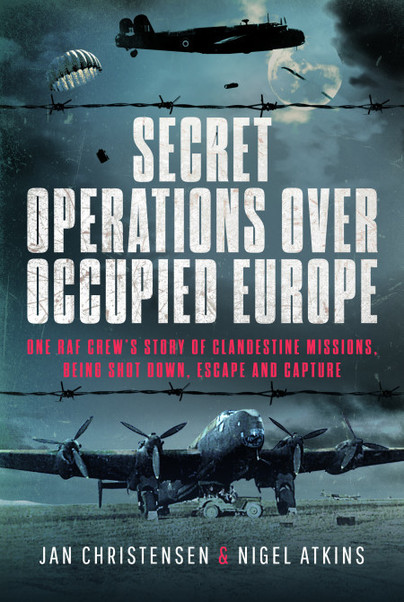
For several months in 1943, seven young airmen, all volunteers, were moulded into an RAF crew tasked with undertaking perilous operations over Occupied Europe. Drawn together from England, Argentina, and Canada, the crew, led by their captain, Flight Lieutenant Peter Bartter, were assigned to 138 (Special Duties) Squadron, based at RAF Tempsford. It was there that they flew low, over dangerous territory to deliver agents and equipment to aid the Resistance in Occupied Europe.
When the Allies opened new fronts in North Africa and Italy, Bartter’s crew was seconded for some weeks to 624 Squadron flying from Blida in Algeria and Protville in Tunisia. On their return to the UK, they had the additional task of bringing back Winston Churchill’s son, Randolph.
The crew’s last operation would be to fly Flemming Muus, as head of SOE in Denmark, to Roskilde in Denmark. However, tragedy struck when their Halifax Mk.II, BB378, was shot down approaching its destination on the night of 10/11 December 1943.
Exemplary piloting skills from Peter Bartter brought the aircraft down in a frozen field with no injuries. Muus thankfully escaped. The crew, meanwhile, split into two groups – the officers, and the NCOs.
The officers managed to evade capture and reach Sweden. One of the officers, Ernesto Howell, went on to re-join 138 Squadron, but was sadly killed flying over the North Sea in November 1944.
The NCOs’ luck gave out, and they were all captured, spending the rest of the war in the notorious Stalag IV-B. From there, one of the NCOs managed to escape just before the camp liberated by the Russians.
In this book, the crew are traced from their recruitment, to training, deployment and, for the survivors, their post-war lives. The next generation, René, son of agent Ernest Gimpel, and Nigel Atkins, son of Brian Atkins, the co-pilot, have become firm friends. Nigel Atkins travelled across Europe on a journey of discovery as he has met and interviewed many people while visiting multiple locations the crew only visited from above.
From daring flights over occupied Europe to meetings over seventy years later, the excavation of the crash site, and new friendships formed, this book has it all.
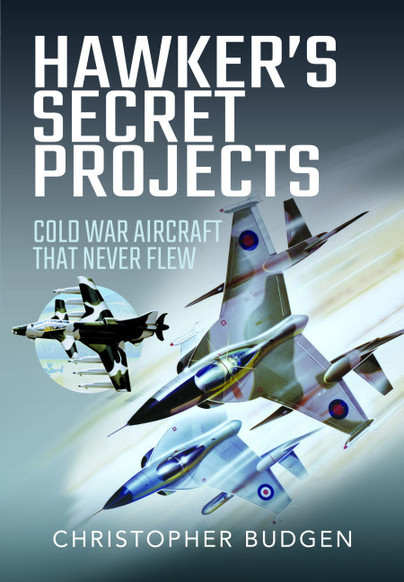
Hawker Aircraft Ltd at Kingston was arguably the most successful and long-lasting manufacturer of military aircraft in Great Britain and Europe. In its various evolved manifestations – Hawker Aircraft, Hawker Siddeley Aviation, British Aerospace – its output of war winning aircraft, mainly fighters, was unsurpassed. From the Hart and Hurricane through the Hunter, Harrier and Hawk, the company consistently produced aircraft that the UK fighting services wanted. But some designs, for whatever reason, failed to reach flight or were declined by the services.
With their sometimes advanced aerodynamics and technology, these aircraft could have had successful service careers but instead were abandoned, their stories failing to reach mainstream consciousness. Having not received their just dues, the present book seeks to redress this omission. The reasons for failure are many and varied, often financial or political, but in each case the reasons behind the failure of the design are examined.
In a wide-ranging investigation that documents the origins of Hawker Aircraft Ltd and its famous Project Office, this work, the third in Christopher Budgen’s investigation of the inner workings of Hawker Aircraft, is a fitting tribute to the many who made the company the success it was.
NEWS |
Asio says violent rightwing extremists are still being inspired by the Christchurch mosque shooting massacre carried out by an Australian man in 2019, warning of an uptick in activity from hate groups “who want to trigger a so called ‘race war’”.
And the home affairs department has told a parliamentary inquiry into rightwing extremism that it is seeing increasing imports of Nazi imagery into Australia despite a ban on displaying such symbols, and has also raised alarm about violent extremist groups targeting councils in Victoria due to their support for the LGBTQ+ community.
A government register introduced following one of Australia’s worst data breaches on record has blocked more than 300,000 fraudulent attempts to use stolen identity credentials legitimately in 18 months.
The figures reveal for the first time the scale of attempts by fraudsters to use compromised passports, Medicare and driver’s licence data in the wake of the 2022 Optus data breach that kicked off a privacy push.
As many as 9.8 million current and former Optus customers had at least some personal information compromised in the breach, while at least 2.1 million customers had identity documents stolen, prompting a rush for replacement credentials.
ARTICLES |
The expert consensus is that human-like machine intelligence is still a distant prospect, with only a 50-50 chance that it could emerge by 2059. But what if there was a way to do it in less than half the time?
We’ve partnered with VERSES for the final entry in our AI Revolution Series to explore a potential roadmap to a shared or super intelligence that reduces the time required to as little as 16 years.
Active Inference and the Future of AI
The secret sauce behind this acceleration is something called active inference, a highly efficient model for cognition where beliefs are continuously updated to reduce uncertainty and increase the accuracy of predictions about how the world works.
An AI built with this as its foundation would have beliefs about the world and would want to learn more about it; in other words, it would be curious. This is a quantum leap ahead of current state-of-the-art AI, like OpenAI’s ChatGPT or Google’s Gemini, which once they’ve completed their training, are in essence frozen in time; they cannot learn..
The late Daniel Kahneman wrote one of the best books on the psychology of communication.
Daniel Kahneman, the Princeton University psychology professor credited with laying the foundation of behavioral science, died last month at the age of 90. Kahneman and his famed partner, Amos Tversky, uncovered a long list of cognitive biases that affect our thinking and decision-making.
In 2011, about a decade after Kahneman won a Nobel Prize for his work, he published Thinking, Fast and Slow. I revisit it at least once a year because it’s the best book on persuasion even though it doesn’t have ‘persuasion’ or ‘communication’ in the title.
With Kahneman’s insights, you’ll understand the human mind and the tactics to persuade those minds to pay attention to your ideas.
REPORT |
The world has changed. The number one priority for talent development teams is helping organisations understand and leverage generative AI. To do that, talent development teams need to use gen AI themselves. Ethan Mollick thinks at least 5-10 hours of actively using AI on work tasks is the minimum to understand the true capabilities - and weaknesses - of the various models. To get to those hours, you need to identify simple and compelling use cases.
So we're pleased to release our exclusive research: The Top 100 Use-cases for Generative AI. A piece discussing the methodology and the findings of the work has been published by Harvard Business Review. This page is devoted to the full set of results.
OPINION |
Closer co-operation between government, business and civil society organisations would support more ‘whole-of-nation’ approaches to geopolitical competition.
There had once been hope in the West that China’s adoption of free market principles would eventually see it become more like us. Today, to compete with China’s national power, it seems we need to become more like it.
It’s been more than a decade since the then Gillard government released Australia’s first national security strategy, flagging an expectation that an updated strategy should be created every five years to set out key objectives and priorities to keep Australians safe.
Now, with a reduction in strategic warning time, an evolving set of threats and, above all, a collapse of the distinction between our economic and security interests, there is a case for an updated national security strategy to improve co–ordination between government agencies and explain to the public of how it plans to protect Australia’s vital interests.
Amid a rapidly changing geopolitical environment, the elements of national security are broadening and becoming more connected. As just a few examples, technology–enabled foreign interference and disinformation are proliferating, Covid and the invasion of Ukraine have highlighted supply chain dependencies, and there is a growing acceptance that energy and climate challenges will complicate the security environment.
TALKS, WEBINARS & PRESENTATIONS |
Born to the British upper-crust - devoted to the Revolution. Harold 'Kim' Philby was the ultimate Soviet superspy.
For decades, Philby sold secrets to the Russians from inside the upper echelons of MI6. Inspired by an unpublished memoir recently acquired by Spyscape, we bring his fascinating story to life.
In Part 1, Rhiannon Neads details Philby's rise to the top - and the fateful decisions that will lead to his undoing.
Back to the Resource Hub / Back to Links
The subjects, thoughts, opinions, and information made available in AIPIO Acumen reflect the authors' views, not those of the AIPIO.