
Back to the Resource Hub / Back to Links
The links below are organised by the month in which they are published
BOOKS |

Love, betrayal, and a secret war: the untold story of two elite agents, one Canadian, one British, who became one of the most decorated couples of WWII.
On opposite sides of the pond, Sonia Butt, an adventurous young British woman, and Guy d’Artois, a French-Canadian soldier and thunderstorm of a man, are preparing for war.
From different worlds, their lives first intersect during clandestine training to become agents with Winston Churchill’s secret army, the Special Operations Executive. As the world’s deadliest conflict to date unfolds, Sonia and Guy learn how to parachute into enemy territory, how to kill, blow up rail lines, and eventually . . . how to love each other. But not long after their hasty marriage, their love is tested by separation, by a titanic invasion—and by indiscretion.
Writing in vivid, heart-stopping prose, Ayed follows Sonia as she plunges into Nazi-occupied France and slinks into black market restaurants to throw off occupying Nazi forces, while at the same time participating in sabotage operations against them; and as Guy, in another corner of France, trains hundreds into a resistance army.
Reconstructed from hours of unpublished interviews and hundreds of archival and personal documents, the story Ayed tells is about the ravaging costs of war paid for disproportionately by the young. But more than anything, The War We Won Apart is a story about love: two secret agents who were supposed to land in enemy territory together, but were fated to fight the war apart.
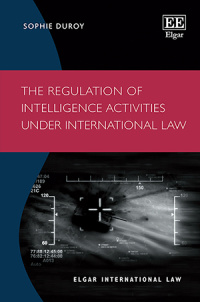
Presenting a thorough examination of intelligence activities in international law, Sophie Duroy provides theoretical and empirical justifications to support the cutting-edge claim that states’ compliance with international law in intelligence matters serves their national security interests.
This book theorises the regulation of intelligence activities under international law, identifying three layers of regulation: a clear legal framework governing intelligence activities (legality); a capacity to enforce state responsibility (accountability); and the integration of legality and accountability into responsive regulation by the international legal order (compliance). The empirical relevance of these three layers of regulation is demonstrated through in-depth case studies of state responsibility in the CIA-led war on terror and an analysis of the accountability of Djibouti, the Gambia, Poland, the United Kingdom, and the United States for conduct in the CIA-led war on terror. Overall, the author shows that the most reliable path to long-term national security is the effective regulation of intelligence activities under international law.
Making an original contribution to existing theories of compliance and regulation, as well as the law of state responsibility and its enforcement, this book will be essential for students and scholars of public international law, human rights, intelligence and security studies, and international relations. It will also be a valuable resource for practitioners of international law with an interest in intelligence, state responsibility, and terrorism and security law.
NEWS |
Intelligence diplomacy—“liaison” is the term of art—is a key, if often hidden, element of national power. Washington has more liaison partners than is publicly known, because countries and even nonstate groups that do not wish to be seen engaging with American officials still speak with the United States government via clandestine channels. Traditionally, liaison relationships are unaffected by international politics and shifts in foreign policy; administrations come and go, and the intelligence flows uninterrupted. But occasionally, political developments are so dramatic that they intrude on intelligence liaison.
The Senate voted Wednesday to confirm Tulsi Gabbard as President Trump's director of national intelligence, largely along party lines.
Why it matters: It's a big win for the president's team, which worked hard to resuscitate Gabbard's nomination when it faltered earlier this year.
The final vote was 52-48, with former Republican Leader Mitch McConnell (R-Ky.) the only GOP opponent.
"When a nominee's record proves them unworthy of the highest public trust, and when their command of relevant policy falls short of the requirements of their office, the Senate should withhold its consent," McConnell said in a statement after the vote.
ARTICLES |
Blockchain technology represents a powerful tool for innovation. Cryptocurrencies – the most prominent use case of blockchain technology – enable low-cost, high-speed value transfers, democratise access to financial services, and have even introduced new ways to support charitable causes through transparent, auditable donations.
As with many innovations, however, malign actors have weaponised the same features that make crypto a force for good. From Russian ransomware gangs to North Korean hackers, threat actors exploit the decentralised and pseudonymous nature of digital currencies to generate revenue, launder money, evade sanctions, and conduct other illicit activities.
Many believe blockchain-based transactions lie beyond the reach of governments because they occur outside the verification and surveillance mechanisms of the traditional financial system. The reality, however, is the opposite. National security and law enforcement agencies around the world are harnessing the power of enriched blockchain intelligence to track, trace, and disrupt the flow of illicit funds in ways that were previously unimaginable.
The idea of the “Australian Briton” was central to the nation’s identity for nearly 200 years, joining Australian life to a love of Britain and its empire. That Anglophile Scot, Sir Robert Menzies, proclaimed he was “British to the bootstraps,” and many Australians of his generation walked proudly in the same boots. The feeling was especially strong among the “good chaps,” those men who knew the world for all its dangers but could be relied on to “do the right thing,” no matter how dirty the job.
Having created the Australian Secret Intelligence Service, our own overseas spy service, the good chaps set about serving the nation while breaking the laws of other nations. The dichotomy was crammed into a single sharp sentence by one of the architects of Australia’s intelligence community, Justice Robert Hope: “In all cases, espionage is illegal and the clandestine service’s job is to break those laws without being caught.” The tensions in the task have seen three ASIS leaders sacked since operations began in 1952.
The spy service’s troubled early life meant it risked being strangled before maturity. Several Australian Britons did good-chap duty cementing its existence, especially the external affairs minister, Dick Casey, and the third ASIS director-general from 1960 to 1968, Walter “Bill” Cawthorn.
REPORT |
Cybercrime makes up a majority of the malicious activity online and occupies the majority of defenders' resources. In 2024, Mandiant Consulting responded to almost four times more intrusions conducted by financially motivated actors than state-backed intrusions. Despite this overwhelming volume, cybercrime receives much less attention from national security practitioners than the threat from state-backed groups. While the threat from state-backed hacking is rightly understood to be severe, it should not be evaluated in isolation from financially motivated intrusions.
A hospital disrupted by a state-backed group using a wiper and a hospital disrupted by a financially motivated group using ransomware have the same impact on patient care. Likewise, sensitive data stolen from an organization and posted on a data leak site can be exploited by an adversary in the same way data exfiltrated in an espionage operation can be. These examples are particularly salient today, as criminals increasingly target and leak data from hospitals. Healthcare's share of posts on data leak sites has doubled over the past three years, even as the number of data leak sites tracked by Google Threat Intelligence Group has increased by nearly 50% year over year. The impact of these attacks mean that they must be taken seriously as a national security threat, no matter the motivation of the actors behind it.
Cybercrime also facilitates state-backed hacking by allowing states to purchase cyber capabilities, or co-opt criminals to conduct state-directed operations to steal data or engage in disruption. Russia has drawn on criminal capabilities to fuel the cyber support to their war in Ukraine. GRU-linked APT44 (aka Sandworm), a unit of Russian military intelligence, has employed malware available from cybercrime communities to conduct espionage and disruptive operations in Ukraine and CIGAR (aka RomCom), a group that historically focused on cybercrime, has conducted espionage operations against the Ukrainian government since 2022. However, this is not limited to Russia. Iranian threat groups deploy ransomware to raise funds while simultaneously conducting espionage, and Chinese espionage groups often supplement their income with cybercrime. Most notably, North Korea uses state-backed groups to directly generate revenue for the regime. North Korea has heavily targeted cryptocurrencies, compromising exchanges and individual victims’ crypto wallets.
OPINION |
Many moons ago, when I was a baby intel officer at the CIA, I took a lengthy course on intelligence analysis. A large focus of this course was on intelligence failures, both recent (9/11, Iraq WMD) and long past (Pearl Harbor, Yom Kippur War) with an eye towards learning from past failures to prevent future ones.
It was drilled into us there that good analysis requires an understanding of past failure and a willingness to honestly accept and confront those failures. And the same is true of good policy. In that light, I wanted to take off my crime data analyst hat and put on my former intel analyst hat for a post that examined the horrific tragedy which befell my hometown earlier this year.
TALKS, WEBINARS & PRESENTATIONS |
Dig into the world of Australian intelligence with Rachel Noble, the groundbreaking Director-General of the Australian Signals Directorate (ASD). In this exclusive SpyCast episode, Noble shares insights from her 30-year career in intelligence and her historic role as the first woman to lead an Australian intelligence organization.
Discover: The mission and purpose of the Australian Signals Directorate. The truth behind the Pine Gap spy facility. Origins of the Five Eyes alliance Leadership lessons from the top of intelligence. Balancing national security and work-life. Noble discusses the evolving landscape of cyber defense, the importance of diversity in intelligence, and reflects on her impactful career as she prepares to retire from public service.
Back to the Resource Hub / Back to Links
The subjects, thoughts, opinions, and information made available in AIPIO Acumen reflect the authors' views, not those of the AIPIO.