Back to the Resource Hub / Back to Links
The links below are organised by the month in which they are published
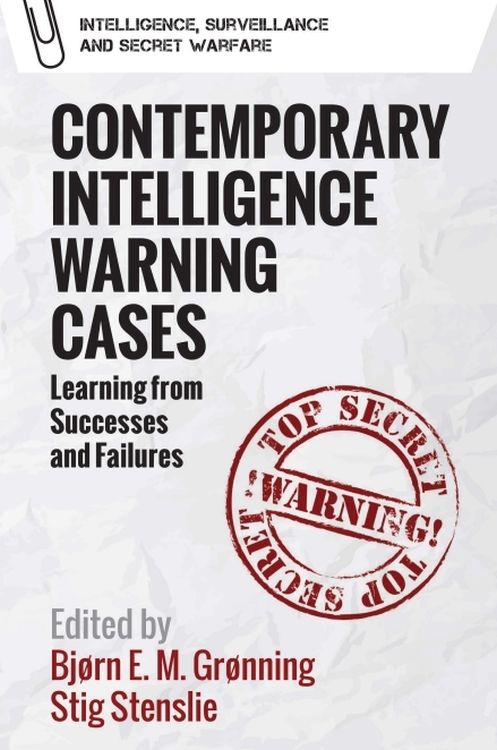
Contemporary Intelligence Warning Cases: Learning from Successes and Failures Edited by Bjorn Elias Mikalsen Groning, Stig Stenslie
What can intelligence producers and users learn from contemporary intelligence warning cases to anticipate, prepare for, mitigate and prevent future security challenges? A multiple case-study of contemporary intelligence warning (2006-2023). It features a broad spectrum of traditional and non-traditional intelligence problems, ranging from invasions and wars, through terrorist attacks and hybrid warfare, to pandemics, financial crises, climate change, strategic acquisitions, and attacks on cultural heritage. It identifies lessons and practical recommendations for the producers, users and observers of intelligence warning, and for theory.
It presents and synthesizes the findings of 16 contemporary intelligence warning case studies undertaken by leading intelligence scholars and former intelligence practitioners. It is the first multi-case study of intelligence warning and adopts a uniquely broad and contemporary approach to the phenomenon, featuring both successful and failed cases. Consistent with the increasing complexity of intelligence problems and scope of intelligence services, it ranges from traditional warning problems such as invasions and wars, through terrorist attacks, to threats that lie beyond the traditional core scope of intelligence services such as pandemics, financial crises, climate change, strategic acquisitions and attacks on cultural heritage.
Contemporary Intelligence Warning Cases present lessons learned and recommendations for producers and users of intelligence warning in their joint venture to anticipate, prepare for, mitigate, and prevent future threats to national security.
► Know more
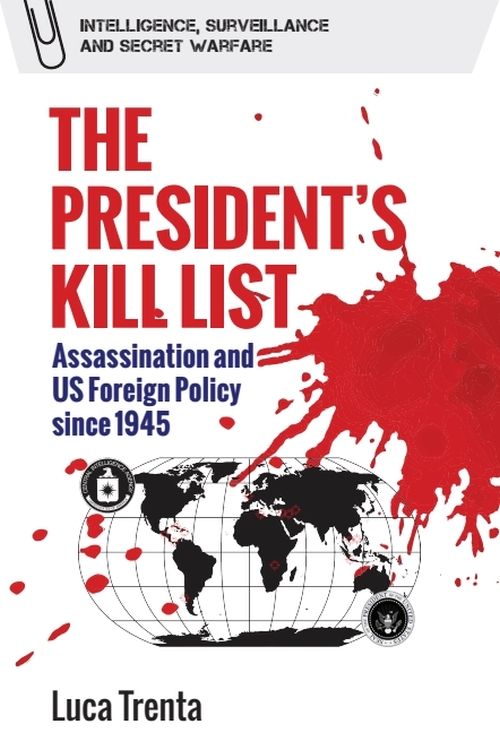
The President’s Kill List Assassination and US Foreign Policy since 1945 By Luca Trenta
Investigates the US government’s involvement in the assassination of foreign officials from the early Cold War to the present day. This book traces continuities in the conduct of US foreign policy and in the arguments used to justify and legitimate assassination plots. It details the direct and indirect methods deployed by the US government to assassinate foreign officials. It utilises extensive and often recently declassified archival material to unveil new details of Cold War and post-Cold War plots. It analyses the secretive decision-making surrounding assassination plots, as well as the extent, nature, and role of presidential orders to kill. It explores and exposes the euphemisms, innuendos, silences, and denials that have long characterised the US government’s approach to assassination.
From Fidel Castro to Qassem Soleimani, the US government has been involved in an array of assassinations and assassination attempts against foreign leaders and officials. The President’s Kill List reveals how the US government has relied on a variety of methods, from the use of poison to the delivery of sniper rifles, and from employing hitmen to simply laying the groundwork for local actors to do the deed themselves. It shows not only how policymakers decided on assassination but also the level of Presidential control over these decisions. Tracing the history of the US government’s approach to assassination, the book analyses the evolution of assassination policies and, for the first time, reveals how successive administrations - through private justifications and public legitimations – ensured assassination remained an available tool.
► For more info
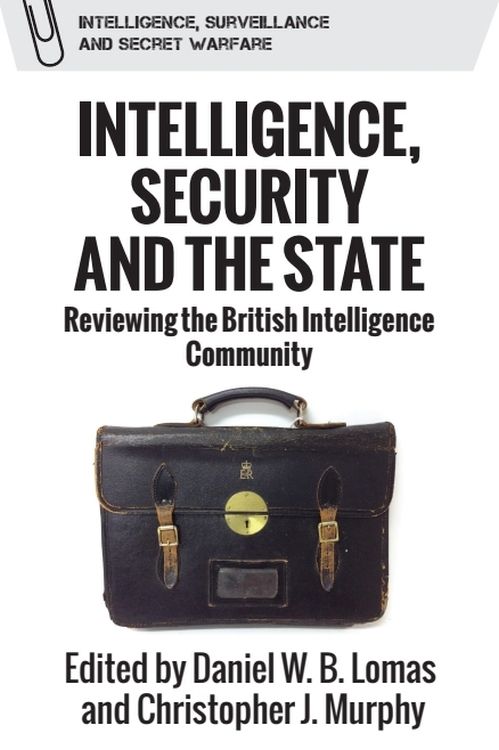 Intelligence, Security and the State Reviewing the British Intelligence Community Edited by Daniel W.B. Lomas, Christopher J. Murphy
This book offers a unique insight into the history and politics of British intelligence with 20 chapters each explore specific reviews of the UK intelligence community, providing an overview of the development of British intelligence. Each chapter reproduces significant extracts from these reviews, with introductory essays drawing on archival documents and the latest academic research to provide wider context. Covers a period of British intelligence history from the origins of the modern-day community in 1909 through to the fallout from the Iraq War. Essential reading for students and academics looking at the machinery of government, UK intelligence, and comparative studies of intelligence agencies
The modern-day UK intelligence and security community is the product of over a century of reviews going back to Edwardian spy scares, through two World Wars, and a Cold War. Written by intelligence experts, Intelligence, Security and the State provides an insight into the development of UK intelligence through a selection of the many intelligence reviews that have taken place during this period. How and why these reviews were commissioned and their impact, if any, is analysed in detail. The reviews cover the origins and early development of the community, alongside the political, operational, and financial oversight of British intelligence. Each of the declassified reviews, reproduced here for the first time, are introduced by short essays giving a wider understanding of the UK intelligence community. The book offers a detailed insight into the machinery of government in the UK and British intelligence as a whole.
► Know more
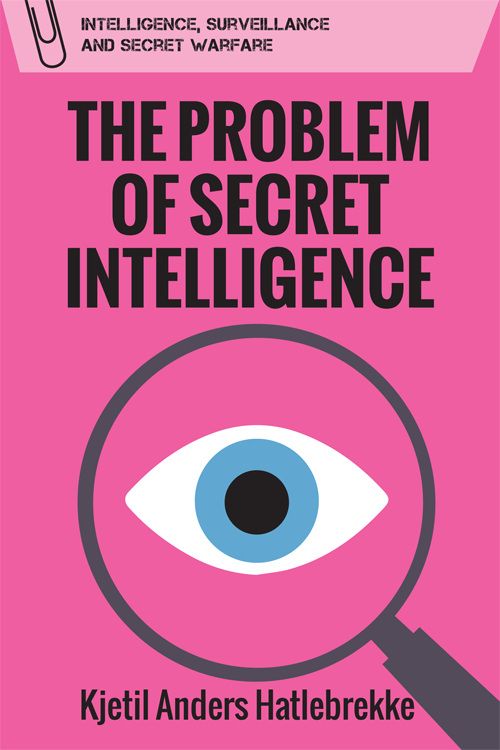
The Problem of Secret Intelligence Kjetil Anders Hatlebrekke
This book systematically develops a new concept of intelligence as a cognitive activity that needs to be understood holistically. It introduces intelligence professionals, decision makers and academics to the potential of intelligence as the art of knowing beyond classic analysis. Provides an innovative understanding and persuasive critique of the problems inherent in using inductive reasoning to undertake intelligence analysis. Demonstrates the importance of creativity and imagination in intelligence production
What is intelligence – why is it so hard to define, and why is there no systematic theory of intelligence? Classic intelligence analysis is based on an inference between history and the future – and this has led to a restriction in how we can perceive new threats, and new variations of threats. Now, Kjetil Anders Hatlebrekke rethinks intelligence analysis, arguing that good intelligence is based on understanding the threats that appear beyond our experience, and are therefore the most dangerous to society.
► For more info
‘It’s beyond human scale’: AFP defends use of artificial intelligence to search seized phones and emails
The Australian Federal Police says it had “no choice” but to lean into using artificial intelligence and is increasingly using the technology to search seized phones and other devices, given the vast amount of data examined in investigations.
The AFP’s manager for technology strategy and data, Benjamin Lamont, said investigations conducted by the agency involve an average of 40 terabytes’ worth of data. This includes material from the 58,000 referrals a year it receives at its child exploitation centre, while a cyber incident is being reported every six minutes.
► Continue reading
Five Eyes nations warn of 'shocking' rise in youth radicalisation
Australia and its international Five Eyes intelligence-sharing network has taken the unprecedented step of jointly warning of a "shocking" rise in youth radicalisation, while urging teachers, parents and health workers to help combat the threat.
Overnight security and law enforcement agencies from Australia, the United States, Canada, the United Kingdom and New Zealand released a first-of-its-kind analysis paper which includes case studies from all five nations.
The Australian Security Intelligence Organisation's (ASIO) director-general Mike Burgess noted that about 20 per cent of his agency's priority counterterrorism cases now involve young people.
► Continue reading
Mexico defends sovereignty as US seeks to label cartels as terrorists
Mexico President Claudia Sheinbaum said that President Donald Trump’s executive order moving toward designating drug cartels as foreign terrorist organizations would only impact Mexico if there’s close coordination between the two governments.
She said that Mexico would defend its sovereignty and independence while seeking coordination with the U.S. in the wake of the order signed Monday.
“We all want to fight the drug cartels,” Sheinbaum said at her daily press briefing. The U.S. “in their territory, us in our territory.”
Trump’s order highlighted Mexican drug cartels and other Latin American criminal groups like Venezuelan gang Tren de Aragua and Salvadoran gang Mara Salvatrucha (MS-13). The order says they “threaten the safety of the American people, the security of the United States, and the stability of the international order in the Western Hemisphere.”
► Continue reading
Navigating Risks in 2025: Insights from the UK National Risk Register
The UK Government has published 2025’s National Risk Register (NRR), a public facing version of the internal and classified National Security Risk Assessment (NSRA). It compiles the impacts and likelihood of wide-ranging malicious and non-malicious threats, such as natural hazards and terrorism, on the UK’s lives, health, society, critical infrastructure, economy, and sovereignty. To be included on the NRR these risks would have a substantial impact on safety, security and/or critical systems at a national level.
The NRR includes information on 89 risks, within nine risk themes, and sets out a ‘reasonable worst-case scenario’ for each. In 2025, for the first time, it has shifted to a dynamic assessment process so that risks can be updated as frequently as needed to capture better evidence or understanding.
This year, the most likely catastrophic-impact rated risk is pandemic, followed by lower likelihood risks of large-scale chemical, biological, radiological and nuclear (CBRN) incidents, and failure of the National Electricity Transmission System (NETS). The most likely risks with a moderate impact include terrorist attacks in publicly accessible locations, technological failure at a systemically important retail bank, and an attack on a UK ally or partner outside of NATO, or a mutual security agreement requiring international assistance.
► Continue reading
Prospects for United Nations Strategic Intelligence
This article analyzes the prospects for strategic intelligence at the United Nations (UN) Secretariat within the framework of the Peacekeeping-Intelligence (PKI) policy that was first published in 2017. It addresses the question of the extent to which the current mechanisms are adequate to meet the strategic intelligence needs of the UN. The article first provides an overview of the strategic information and analysis entities at the UN headquarters (UNHQ) and how they interface with the PKI processes in the field missions. Second, it examines the strategic management of PKI systems and organization at the mission level through the framework of the Mission Peacekeeping-Intelligence Coordination Mechanism (MICM). The analysis of UNHQ analytical entities shows a disparate network that is not synchronized into a coherent system. The mechanisms are further undermined by inherent bureaucratic and institutional flaws. While the MICM has provided a firm basis for developing a strategic PKI framework at the mission level, its application needs time to be tested by events. The article argues that, although the UN has made significant strides in developing the PKI framework, the current structures both at UNHQ and the mission level require specific adaptations to enhance the utility of the mechanisms.
► Read more
Moral Risk, Moral Injury, and Institutional Responsibility: Ethical Issues in HUMINT
Intelligence is morally unique—means and ends that are typically morally problematic are rendered justifiable by reference to the special purpose that national security intelligence serves. This is particularly the case with human intelligence (HUMINT), where operators and handlers might have to violate normal ethical principles as part of their job. Lying, coercion, and/or exploitation may feature as part of a HUMINT operation. This creates a moral risk, where individuals and institutions are excepted from normal moral constraints. Rather than looking at the immediate moral risks of HUMINT operations, this article looks at the relation between the moral risks encountered as part of HUMINT and moral injury. Moral injury may refer to two complementary phenomena: when a person is exposed to immoral activities and suffers psychologically because of dissonance between those immoral activities and normal moral behaviors, and when a person’s moral character is “numbed” because of them engaging in immoral activities. HUMINT exposes intelligence officers to both kinds of moral injury. There is a moral responsibility of intelligence institutions to be both aware of, and seek to mitigate, moral injury, while operating in a context where such moral risk is at times justifiable.
► Know more
GhostGPT: Uncensored Chatbot Used by Cyber Criminals for Malware Creation, Scams
Researchers from Abnormal Security discovered an advert for the chatbot on a cybercrime forum and tested its capabilities by asking it to create a DocuSign phishing email.
Security researchers have discovered a new malicious chatbot advertised on cybercrime forums. GhostGPT generates malware, business email compromise scams, and more material for illegal activities.
The chatbot likely uses a wrapper to connect to a jailbroken version of OpenAI’s ChatGPT or another large language model, the Abnormal Security experts suspect. Jailbroken chatbots have been instructed to ignore their safeguards to prove more useful to criminals.
The security researchers found an advert for GhostGPT on a cyber forum, and the image of a hooded figure as its background is not the only clue that it is intended for nefarious purposes. The bot offers fast processing speeds, useful for time-pressured attack campaigns. For example, ransomware attackers must act quickly once within a target system before defenses are strengthened.
► Read more
Geopolitical Consequences of Ukraine’s Defeat
Russia’s economic and societal adaptation for a long war is leaving Ukraine outgunned and outmanned, and its allies are left to scramble for ammunition around the world. The bravery and dedication of the Ukrainians fighting for their loved ones and their country will become a part of future case studies on maintaining resilience, innovation, and morale against significant odds. Nevertheless, the worrisome trends, including a disadvantage in manpower, ammunition production and long-range weapons, leave a Ukrainian defeat a possibility, especially without U.S. help. Perhaps just as worrisome are societal trends and what appears to be somewhat diminished support for aid to Ukraine.
The United States has significant interests in Europe that are worth defending. The United States and the European Union (EU) plus the United Kingdom account for almost half of the world economy. North Atlantic Treaty Organization (NATO) member states in Europe are America’s largest export market. Ukraine is a part of Europe. What would be the geopolitical consequences of Ukraine’s defeat? In other words, why is it essential for the West, including the United States, to continue to support Ukraine in its fight against Russia’s unjustified, illegal, and brutal invasion?
► Know more
Estimating the costs of serious and organised crime in Australia, 2022–23
This report estimates the cost of serious and organised crime in Australia in 2022–23 to be between $30.4b and $68.7b. This is the fourth in a series of reports undertaken for the Australian Criminal Intelligence Commission estimating the cost of serious and organised crime. It updates and improves on the methodology used in the previous report, which estimated the cost of serious and organised crime in 2020–21 to be between $24.8b and $60.1b. As with the previous research, this report considers the direct and consequential costs of serious and organised crime in Australia, as well as the costs to government entities, businesses and individuals associated with preventing and responding to serious and organised crime. The current estimate includes the cost of some additional crime types, not previously included, but even accounting for these additions it is clear that serious and organised crime continues to impose a substantial burden on the Australian economy.
► Read the report
Risk: A Weak Element in U.S. Strategy Formulation
Risk is an enduring reality in strategic decisionmaking. The rigorous assessment of risk is—or should be—a critical step in strategy development. There is always risk in any strategy thanks to the unrelenting reality of uncertainty in human affairs.1 Yet it is often a weak link in U.S. strategy formulation and decisionmaking. Thus, this article is focused on the role of strategic risk, how we define risk and operationalize it, and how senior leaders employ risk analysis to improve strategic performance. The thesis for this article is simple: strategic risk is not well understood, and risk analysis should be a routine and continuous part of the strategy-formulation process.
► Read the report
AI threatens independent thinking
What if meticulous hours of note taking, grueling Quizlets and long nights powered by questionable amounts of caffeine ceased to exist? Thanks to artificial intelligence, it can. The current education climate has several problems with AI, plagiarism and academic dishonesty, so Eastern’s dean of students and Faculty Development and Innovation Center created student and faculty AI guides
While some professors may allow AI use in their classrooms, many do not. Eastern has not adopted a campus-wide AI policy but has rather left the choice up to its educators. For students, the new AI guides echo what the Code of Conduct plagiarism section says but adds examples of how to and not to use AI. Additionally, Booth Library developed its own source credibility tutorial to assist students with their AI literacy and source checking.
In an attempt to assist with and regulate AI use in her classroom, Katherine Lewandowski, a geology professor, created a new policy in line with the FDIC around AI for this year. Her policy states students may use AI such as ChatGPT, Grammarly or Dall-E 2 only if they are cited correctly and include the prompt text and two-to-three sentences about how the tool was used. She said this policy allows students to use the tools they could already be using. Lewandowski created this policy because of consistent AI problems last year. AI has unintentionally streamlined the cheating process and has begun to produce more academically dishonest students.
“If [students] have a paper written by a computer, it’s still wrong,” she said. “It’s still not their own work and part of going to university is doing your own work.”
► Read more
The Humble Brag: China’s Recent Wargame and Its Implications
A Chinese simulation admitting to a PLAN destroyer's defeat by US missiles hints at advanced electronic warfare capabilities while raising questions about PLA transparency and messaging.
On 4 January 2025, the South China Morning Post (SCMP) newspaper published an article detailing how a Chinese-run ‘wargame’ had modelled the sinking of a People’s Liberation Army Navy (PLAN) destroyer by US missile attack. The missiles in question were the Lockheed Martin-made, US Navy/Air Force-employed AGM-158C Long Range Anti-Ship Missiles (LRASM). Given that these missiles are specifically designed to sink ships from range, the fact that they did so in a simulation is hardly remarkable. That such a simulation should be run and documented in a peer-reviewed academic publication is possibly a little more surprising, given Chinese military sensitivity. What is noteworthy is that the institute which ran the simulation is one that provides modelling and simulation tools for the PLA and is one of the institutes run by the China Electronics Technology Corporation (CETC), a powerful state-owned enterprise which has been involved with projects including China’s nuclear and satellite programmes. The decision of academics from the 15th Institute who presumably hold security clearances to provide interviews to a pro-Chinese government publication, a promoter of Chinese ‘soft power’ (the SCMP) would presumably have occurred with state encouragement or at a minimum approval. This raises the question of why seemingly negative results were published in an English-language newspaper which is accessible to foreign audiences. Moreover, what can be understood regarding the People’s Liberation Army’s (PLA) assessment of its own capabilities based on the outcome of the exercise? This article seeks to provide some plausible rationales for the PLA to publicise the seemingly disappointing results of this simulation.
► Read more
TALKS, WEBINARS & PRESENTATIONS
|
The International Journalists' Network
Open Source Intelligence (OSINT) is a pivotal source of information for investigative journalists globally. In this IJNet Forum, Eoghan Macguire of Bellingcat teaches journalists how they can utilize this data.
► Watch here
Navigating Noise Podcast: Why Open Source Intelligence Could Be Hurting the Future of National Security with Jeff Rogg, author of The Spy and The State
The historical evolution of American intelligence offers a lens through which to understand today’s complex national security challenges. As the information landscape becomes increasingly vast and nuanced, tracing the trajectory of intelligence—from its origins to its current form—provides insights into the interplay between secrecy, trust, and the public-private partnerships that define its practice.
My conversation with Jeff Rogg, the author of the forthcoming book, The Spy and The State, helped me to examine these historical precedents. Together we uncovered lessons on navigating technological disruption, fostering trust, and balancing transparency with national security imperatives.
► Know more
Back to the Resource Hub / Back to Links
The subjects, thoughts, opinions, and information made available in AIPIO Acumen reflect the authors' views, not those of the AIPIO.
