
Back to the Resource Hub / Back to Links
The links below are organised by the month in which they are published
BOOKS |
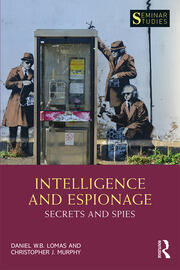
Intelligence and Espionage: Secrets and Spies provides a global introduction to the role of intelligence – a key, but sometimes controversial, aspect of ensuring national security. Separating fact from fiction, the book draws on past examples to explore the use and misuse of intelligence, examine why failures take place and address important ethical issues over its use.
Divided into two parts, the book adopts a thematic approach to the topic, guiding the reader through the collection and analysis of information and its use by policymakers, before looking at intelligence sharing. Lomas and Murphy also explore the important associated activities of counterintelligence and the use of covert action, to influence foreign countries and individuals. Topics covered include human and signals intelligence, the Cuban Missile Crisis, intelligence and Stalin, Trump and the US intelligence community, and the Soviet Bloc. This analysis is supplemented by a comprehensive documents section, containing newly released documents, including material from Edward Snowden’s leaks of classified material.
Supported by images, a comprehensive chronology, glossary, and 'who’s who' of key figures, Intelligence and Espionage is an invaluable resource for anyone interested in the role of intelligence in policymaking, international relations and diplomacy, warfighting and politics to the present day.
Technology is turning spycraft upside down. Once, intelligence operations could employ James Bond-style forgeries and disguises to infiltrate a target, but modern-day spies must succeed at the seemingly impossible: to hide in plain sight in a world where everything is visible.
Our technology-reliant lives are a trail of electronic interactions; from card payments to CCTV, we leave involuntary and often unwitting digital footprints. Faking this online trail is hard, while the lack of one is dangerously conspicuous. When even an expertly forged ID has little chance against biometric databases and facial recognition technology, how can open societies’ intelligence agencies continue to operate undercover?
In this gripping, meticulously researched study, drawing on numerous real-life cases, Edward Lucas, an acclaimed espionage expert, tracks the changing landscape of international spycraft—and highlights the West’s growing disadvantage against its autocratic adversaries.
This book examines to what extent geopolitics explains the current wave of force modernisation in the Indo-Pacific region. Examining the leading Indo-Pacific nations in terms of defence spending: the United States, China, India, Japan, South Korea, Australia, Taiwan, Singapore, Pakistan, Indonesia and Thailand, geopolitical principles are used to create hypotheses that can be tested against the military modernisation programmes of the major actors in the Indo-Pacific region. The book represents a bridge between reference works and the literature on international politics in the Indo-Pacific. The empirical chapters provide qualitative narratives that explore the force postures, military modernisation and procurement patterns of the cases, and assess why these nations’ military modernisation has followed particular courses and evaluate this evidence against the expectations of geopolitics and its rivals.
This book will be a valuable addition to scholars, practitioners and, indeed, anyone interested in the future stability of one of the world’s most important and dynamic regions.

Strategic intelligence (SI) has mostly been used in military settings, but its worth goes well beyond that limited role. It has become invaluable for improving any organization's strategic decision making process. The author of Strategic Intelligence: Business Intelligence, Competitive Intelligence, and Knowledge Management recognizes synergies among component pieces of strategic intelligence, and demonstrates how executives can best use this internal and external information toward making better decisions.
Divided into two major parts, the book first discusses the convergence of knowledge management (KM), business intelligence (BI), and competitive intelligence (CI) into what the author defines as strategic intelligence. The second part of the volume describes case studies written by recognized experts in the fields of KM, BI, and CI. The case studies include strategic scenarios at Motorola, AARP, Northrop Grumman, and other market leaders.
 Confronting Cyberespionage Under International Law by By Oğuz Pehlivan
 We have witnessed a digital revolution that affects the dynamics of existing traditional social, economic, political and legal systems. This revolution has transformed espionage and its features, such as its purpose and targets, methods and means, and actors and incidents, which paves the way for the emergence of the term cyberespionage. This book seeks to address domestic and international legal tools appropriate to adopt in cases of cyberespionage incidents. Cyberespionage operations of state or non-state actors are a kind of cyber attack, which violates certain principles of international law but also constitute wrongful acquisition and misappropriation of the data. Therefore, from the use of force to state responsibility, international law offers a wide array of solutions; likewise, domestic regulations through either specialized laws or general principles stipulate civil and criminal remedies against cyberespionage.
Confronting Cyberespionage Under International Law examines how espionage and its applications have transformed since World War II and how domestic and international legal mechanisms can provide effective legal solutions to this change, hindering the economic development and well-being of individuals, companies and states to the detriment of others. It shows the latest state of knowledge on the topic and will be of interest to researchers, academics, legal practitioners, legal advisors and students in the fields of international law, information technology law and intellectual property law.
This book tracks post 9/11 developments in national security and policing intelligence and their relevance to new emerging areas of intelligence practice such as: corrections, biosecurity, private industry and regulatory environments.
Issues explored include: understanding intelligence models; the strategic management challenges of intelligence; intelligence capacity building; and the ethical dimensions of intelligence practice. Using case studies collected from wide-ranging interviews with leaders, managers and intelligence practitioners from a range of practice areas in Australia, Canada, New Zealand, the UK and US, the book indentifies examples of good practice across countries and agencies that may be relevant to other settings.
Uniquely bringing together significant theoretical and practical developments in a sample of traditional and emerging areas of intelligence, this book provides readers with a more holistic and inter-disciplinary perspective on the evolving intelligence field across several different practice contexts.
Intelligence and Intelligence Analysis will be relevant to a broad audience including intelligence practitioners and managers working across all fields of intelligence (national security, policing, private industry and emerging areas) as well as students taking courses in policing and intelligence analysis.
NEWS |
It was just a few months ago that speculation was rife of a shake-up of Australia’s spy and security chiefs in the wake of the spectacular cratering of former Home Affairs secretary Mike Pezzullo, especially as a succession of key leaders contracts approached renewal date.
Recently, the Albanese government resisted any urge to purge, sending its firmest signal yet of trust in the incumbent intelligence community with the reappointment of Australian Security Intelligence Organisation Director-General Mike Burgess for another five years.
The AFP has charged a West Australian man who allegedly established fake free WiFi access points, which mimicked legitimate networks, to capture personal data from unsuspecting victims who mistakenly connected to them.
The man, 42, is expected to appear in Perth Magistrates Court today (28 June, 2024) to face nine charges for alleged cybercrime offences.
Analysis by the AFP’s Western Command Cybercrime Operations Team of data and devices seized from the man has allegedly identified dozens of personal credentials belonging to other people as well as fraudulent WiFi pages.
Police charged the man last month (May, 2024) after launching an investigation in April, 2024, when an airline reported concerns about a suspicious WiFi network identified by its employees during a domestic flight.
Two Russian-born Australian citizens accused of obtaining Australian Defence Force material to share with Russia have been named and were due to face Brisbane Magistrates Court on Friday over espionage-related offences.
The married couple are Australian Defence Force Army Private Kira Korolev, 40, who faced the Brisbane Magistrates court on Friday and self-employed labourer Igor Korolev, 62 - who is yet to appear. They are facing one count each of preparing to commit an espionage offence.
“There are a couple of critical points that I want to make today. This alleged criminality has been disrupted. Currently, no significant compromise has been identified.
“Our Five Eyes partners and the Australian Government can be confident that the robust partnerships within the counter foreign interference task force mean we will continue to identify and disrupt espionage and foreign interference activity. I want to thank the very clever members of the AFP, ASIO and those individuals in the task force for their ingenuity and determination.”
ASIO Director-General of ASIO Mike Burgess said the developments were a warning to foreign spies targeting Australia.
The normally secretive U.S. intelligence community is as enthralled with generative artificial intelligence as the rest of the world, and perhaps growing bolder in discussing publicly how they’re using the nascent technology to improve intelligence operations.
“We were captured by the generative AI zeitgeist just like the entire world was a couple of years back,” Lakshmi Raman, the CIA’s director of Artificial Intelligence Innovation said last week at Amazon Web Services Summit in Washington, D.C. Raman was among the keynote speakers for the event, which had a reported attendance of 24,000-plus.
Raman said U.S. intelligence analysts currently use generative AI in classified settings for search and discovery assistance, writing assistance, ideation, brainstorming and helping generate counter arguments. These novel uses of generative AI build on existing capabilities within intelligence agencies that date back more than a decade, including human language translation and transcription and data processing.
China's Ministry of State Security called on citizens to increase their awareness of security precautions and protect national security in a short film based on a true story about a foreign espionage agency which leveraged a researcher's position to steal the nation's core scientific research achievements through various clandestine means.
The Windmill Code, a microfilm based on a true story, describes how the national security authorities discovered an espionage activity overseas.
Chen Xue, a spy from abroad claiming to be the head of a consulting firm, struck up a conversation with the victim Yang Jian, a researcher at a national scientific institution, at a technological exhibition.
Chen gave Yang a "windmill" as a token and expressed a desire to make friends with him after having such a pleasant talk with him, feeling as though she had met her family.
The victim was captivated by Chen's beauty and was emotionally touched by her, then they quickly fell in love.
A former CIA employee and senior official at the White House National Security Council has been charged with serving as a secret agent for South Korea's intelligence service, the US Justice Department says.
Sue Mi Terry accepted luxury goods, including fancy handbags and expensive dinners at sushi restaurants, in exchange for advocating South Korean government positions during media appearances. She also shared non-public information with intelligence officers and facilitated access for South Korean officials to US government officials, according to an indictment filed in federal court in Manhattan.
She also admitted to the FBI that she served as a source of information for South Korean intelligence, including by passing handwritten notes from an off-the-record June 2022 meeting that she participated in with Secretary of State Antony Blinken about US government policy toward North Korea, the indictment says.
Prosecutors say South Korean intelligence officers also covertly paid her more than $US37,000 ($55,000) for a public policy program that Ms Terry controlled and that was focused on Korean affairs.
ARTICLES |
From human intelligence collection to information gathered in the open, the CIA is leveraging generative artificial intelligence for a wide swath of its intelligence-gathering mission set today, and plans to continue to expand upon that into the future, according to the agency’s AI lead.
The CIA has been using AI for things like content triage and “things in the human language technology space — translation, transcription — all the types of processing that need to happen in order to help our analysts go through that data very quickly” as far back as 2012, when the agency hired its first data scientists, Lakshmi Raman, the CIA’s director of AI, said during an on-stage keynote interview at the Amazon Web Services Summit on Wednesday in Washington, D.C.
On top of that, AI — particularly generative AI in recent years — has been an important tool for the CIA’s mission to triage open-source intelligence collection, Raman said.
Even if movies present the profession as a bunch of babes, beaches, and action, being a spy would be tough. I think I'd rather be a kindergarten teacher or a plumber than risk my life in perilous chases every day. However! Just because I don't want to be sipping martinis with a gun to my head doesn't mean I can't enjoy the films. The best espionage flicks are packed with intrigue and suspense and many of the best elements of the action genre. Here are some titles that will leave you shaken and stirred.
As competition for influence in the Pacific region intensifies, analysis by the Guardian has mapped a vast network of security, policing and defence agreements between the island countries and foreign partners – leading to concerns about militarisation of the region.
The Guardian examined agreements and partnerships covering security, defence and policing with the 10 largest Pacific countries by population. Australia remains the dominant partner in the region – accounting for more than half the deals identified – followed by New Zealand, the US and China.
The data shows more than 60 agreements and initiatives, including several infrastructure and equipment deals, to support defence and policing in Pacific countries. The interactive table below sets out each agreement, and can be searched by country or keyword.
More than half the agreements include a focus on policing, with an emphasis on training of Pacific police forces and donating equipment – a push that comes amid rising transnational crime and threats. China has emerged as a new player in this arena, having developed nearly half a dozen initiatives to support policing in Pacific countries in recent years. Almost all the Pacific countries tracked have deals with multiple partners.
Espionage is the act of collecting secret information, usually through illegal means. It often involves state actors who use spies, agents, and technology to acquire secrets against target countries (or, in some cases, private sector assets). Espionage financing refers to the ways that espionage activities are financed. This can include the amounts of money paid for secrets, how the funds were transferred, how the technologies used for espionage are funded and developed, and even how the money was raised in the first place. This article provides an update on recent events in the espionage finance world and contextualizes it within the broader landscape of illicit finance.
Relatedly, foreign influence or foreign interference is how states deploy spies, agents, or even regular citizens to influence a country’s policies and politics in their favour or interfere in the normal course of politics or life in a country. While just as serious, foreign interference/influence financing looks a bit different from espionage financing, so we’ll deal with that threat in another issue of Insight Monitor.
Imagine a meeting of the U.S. president’s National Security Council where a new military adviser sits in one of the chairs—virtually, at least, because this adviser is an advanced AI system. This may seem like the stuff of fantasy, but the United States could at some point in the not-too-distant future have the capability to generate and deploy this type of technology. An AI adviser is unlikely to replace traditional members of the National Security Council—currently made up of the secretaries of defense, state, and the chairman of the Joint Chiefs of Staff. But an AI presence at the table could have some fascinating—and challenging—implications for how decisions are made. The effects might be even more significant if the United States knew that its adversaries had similar technology at their disposal.
To get a grip on how the proliferation of artificial intelligence might affect national security decisionmaking at the highest levels of government, we designed a hypothetical crisis in which China imposed a blockade on Taiwan and then convened a group of technology and regional experts to think through the opportunities and challenges that the addition of AI would bring in such a scenario. We looked in particular at how the proliferation of advanced AI capabilities around the world could affect the speed of decisionmaking, perception and misperception, groupthink, and bureaucratic politics. Our conclusions were not always what we expected.
The internet, a vast and indispensable resource for modern society, has a darker side where malicious activities thrive. From identity theft to sophisticated malware attacks, cyber criminals keep coming up with new scam methods. Widely available generative artificial intelligence (AI) tools have now added a new layer of complexity to the cyber security landscape. Staying on top of your online security is more important than ever.
The rise of dark LLMs
One of the most sinister adaptations of current AI is the creation of “dark LLMs” (large language models). These uncensored versions of everyday AI systems like ChatGPT are re-engineered for criminal activities. They operate without ethical constraints and with alarming precision and speed. Cyber criminals deploy dark LLMs to automate and enhance phishing campaigns, create sophisticated malware and generate scam content.
REPORT |
Australia’s strategic warning time has collapsed—in response to profound geopolitical shifts. As the ADF is adapting to the hard implications of this change, so must the national intelligence community (NIC).
Australian Government decision-makers need time and insight to identify and prioritise threats (and opportunities) and devise effective responses. Strategic warning intelligence enables and empowers them to do so. But it must be done in a way that keeps up with the rapid pace of geopolitical and technological change, and a widening array of non-traditional strategic threats, and in a fashion best suited to Australia’s circumstances.
To meet this need the NIC should develop a discrete, institutional strategic warning intelligence function—an Australian Centre for Strategic Warning (ACSW). This would recognise the distinct skills, analytical focus and interface with decision-making entailed—and the vital national interests at stake. In implementing an ACSW, much can be learned from our own and other intelligence communities’ ongoing efforts to adapt to threats other than invasion—notably terrorism and pandemics. This will be especially pertinent in its application to grey-zone threats such as economic coercion.
Done right, an ACSW would be an important addition to the suite of Australia’s statecraft tools.
Though little known, a system of voluntary press censorship based on the British D Notice system operated in Australia during the Cold War. The Australian D Notice system, while successful in the early decades of the Cold War, became increasingly contested throughout the 1970s before apparently falling into disuse in the 1980s. The belief that Australia’s D Notice system simply decayed through lack of use is generally accepted by scholars; however, this explanation does not sufficiently convey the complexity behind the breakdown of the system. The system relies heavily on trust and requires a degree of transparency between governments and the press. This article makes the case that a broadening of the definition of national security combined with the simultaneous growth of both investigative journalism and the perception of increased government secrecy was the ultimate cause of the failure of the D Notice system in Australia.
This report explores key security issues in Melanesia from the perspectives of both regional and U.S. experts. Collectively, the essays examine Melanesia’s unique security challenges; assess the impact of strategic competition on countries, governments, and communities; and explore options for how Melanesian nations can manage increased attention from external actors.
OPINION |
Politicking by the Chinese Communist Party has blocked Taiwanese membership of Interpol since 1984, preventing the timely sharing of criminal information and intelligence. The absence of Taiwan in the world’s largest international police organisation weakens global security, to the advantage of organised crime.
Placating the CCP is an insufficient reason for excluding Taiwan from Interpol. To improve global security, Taiwan should finally be granted observer status at Interpol’s 92nd General Assembly in Glasgow in November 2024. It must be given at least a limited capacity to cooperate with Interpol and better combat transnational crime.
Taiwan is a crucial law enforcement stakeholder in the Asia-Pacific region with critical intelligence and operational capabilities. Its police forces, overseen by the National Police Agency (NPA), are known for their professionalism and advanced expertise. Abroad, the NPA actively engages in international efforts against terrorism, cybercrime, human trafficking and drug smuggling. Little wonder that Taiwan has some of the lowest rates of crime in the world.
Despite this success, Taiwanese nationals are still victims of crime at home and abroad, and some are involved in transnational organised crime. The NPA’s absence from Interpol restricts the region’s capacity to effectively combat such activities.
For example, in 2022, Taiwanese police uncovered a new type of human trafficking in Cambodia and Myanmar. Sophisticated organised crime syndicates were promising overseas employment to vulnerable people from around the world, including almost 5000 from Taiwan. Victims were held captive in Cambodia and Myanmar, forced to work in scam call centres under horrendous conditions and subjected to physical and psychological abuse.
It will be a welcome step if the current Independent Intelligence Review (IIR) recommends further empowering the Office of National Intelligence (ONI) to lead capability development and, by extension, to achieve a more collective approach by the many Australian agencies working in the field.
Terms of reference for the IIR encompass progress in the implementation of recommendations from previous reviews, including the establishment of the ONI and the creation of the national intelligence community (NIC). The review has been due to report to the government in mid-2024. Australia’s traditionally federated intelligence community might seem unusual, given its moderate size; it’s more comparable to the notoriously decentralised US intelligence community than those of other Five Eyes countries. Australia typically separates assessment from collection (although not in the case of the Australian Security Intelligence Organisation, or ASIO) and has different agencies for different collection modes (signals, imagery and human intelligence-gathering) and for different intelligence purposes (foreign, defence, security, law enforcement, border and regulatory). The resulting myriad agencies, variously reporting to five ministers, work collaboratively towards common goals.
Charles Beaumont may have come as close as anyone yet to taking the mantle of John le Carre, Britain’s greatest spy novelist and the creator of classics such as “The Spy Who Came in from the Cold” and “Tinker Tailor, Soldier, Spy.” Beaumont has produced a superb book bringing le Carre’s trade right into the 21st Century: “A Spy Alone” (2023), which revolves around the influence Russia has developed over the last two or three decades within the new British establishment.
“A Spy Alone” tells the story of Oxford students — the “Costello Group” — who are drawn into working for Russia by a brilliant academic named Peter Mackenzie and are “handled” by the GRU, Moscow’s military intelligence arm. Against them works the “Pole,” a small unit within MI6 composed of brave, skilled, but very human officers. A superbly drawn former GRU officer Vasya Morozov assists, albeit unwillingly now that he has become something of a “mingarch.” Beaumont’s description of Vasya’s various recruitment strategies as a GRU operator, and his “turning” by the Pole is worth the read alone. One could well believe these incidents were drawn very much from life — and I think it is likely that they were.
TALKS, WEBINARS & PRESENTATIONS |
Joe Weisberg, the Emmy Award-winning creator of The Americans and a former CIA operative, meets Jack Barsky, who was a genuine Soviet "Illegal" operating undercover inside the United States. Host Rory Bremner hears about the amazing real-life inspiration for The Americans, why Joe’s life as an agent was cut short and what happened to Jack when the FBI moved in next door.
As the State Department’s Bureau of Intelligence and Research (INR) marks 75 years of service, what does top leadership feel the past can teach about the future? With the important role of providing independent all-source analysis to foreign policy decision makers at the State Department, White House, and Congress, how do these regional and functional intelligence experts use analytic, foreign language, and social science skills to allow policy makers to make informed foreign policy choices? Find out in this conversation with INR leadership.
The speakers are: Ellen McCarthy, Assistant Secretary of State for the Bureau of Intelligence and Research; Benjamin Brake, Director of the Office of Cyber Affairs; Adrienne Keen, Ph.D., global health and science advisor; and Regina Faranda, Director of the Office of Opinion Research (INR). They will discuss INR’s history and the challenges they see ahead. They will explore how INR analysts draw on knowledge from outside government on issues such as globalization, demography, and technology and how they address the broader definition of national security that encompasses issues such as emerging infectious diseases and emerging technologies.
International Spy Museum Historian and Curator, Vince Houghton, will moderate the discussion, and then you’ll be able to ask questions via our online platform.
The latest series in the Secrets We Keep podcast is called “Nest of Traitors” and follows LiSTNR journalist Joey Watson’s three-year journey to find the spy who betrayed Australia.
During the Cold War an Australian spy turned to work for the enemy, providing intel to the KGB and potentially sabotaging ASIO from the inside.
In this episode of The Briefing, Joey Watson sits down with Sacha Barbour Gatt to talk through his journey into a world of deception
Back to the Resource Hub / Back to Links
The subjects, thoughts, opinions, and information made available in AIPIO Acumen reflect the authors' views, not those of the AIPIO.