
Back to the Resource Hub / Back to Links
The links below are organised by the month in which they are published
BOOKS |
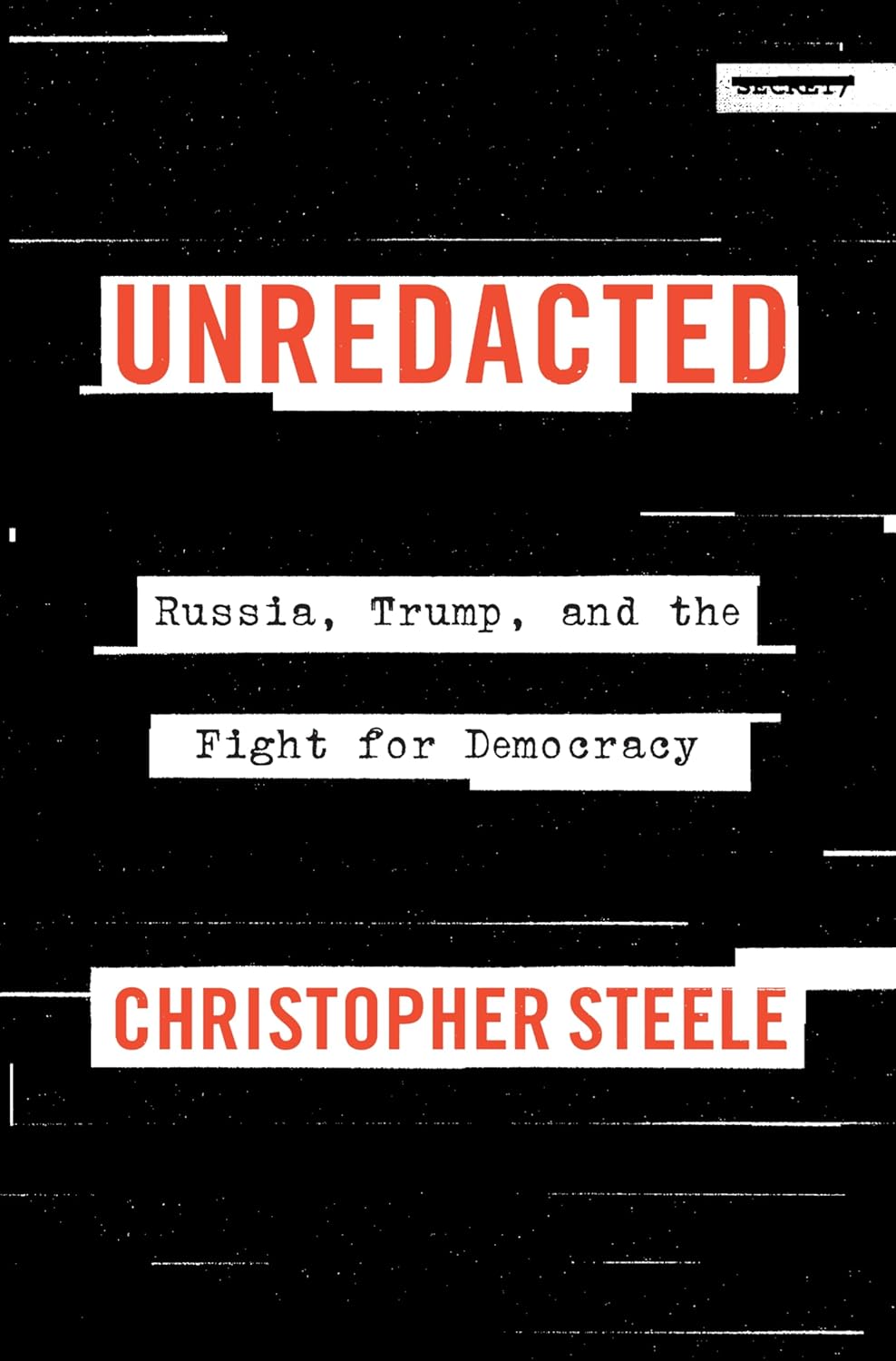
The intelligence officer behind the explosive “Steele Dossier” steps out of the shadows, revealing a searing new report on the threat Putin and Trump pose to democracy, based on alarming intelligence exposed in these pages for the first time
“Putin is now desperate to have Donald Trump back in the White House. If he succeeds in helping Trump get reelected, I am convinced that the global political order will be utterly changed. We shall have entered a new historical era of strategic chaos, a ‘new world disorder.’ The consequences of Trump winning the 2024 election are catastrophic.” –from Unredacted
To a unique degree, Christopher Steele has been an eyewitness observer of modern Russian history. He was a British diplomat and intelligence professional in Moscow when the Soviet Union was collapsing. Steele was there when the putsch against Mikhail Gorbachev took place and when Boris Yeltsin took over the newly independent Russia. After Vladimir Putin came to power, Steele rose to become one of British government’s leading Russia experts and played a central role in the investigation into the Kremlin-ordered murder of Alexander Litvinenko. Then, in 2016, he wrote a series of explosive reports about then presidential candidate Donald Trump and his links to Russia. Now known to the world as the “Steele Dossier,” these intelligence documents drew the world’s attention to Russia’s relationship with Trump—and reluctantly thrust Steele into the center of a global maelstrom.
Since Trump’s election, he has quietly continued his work. Indeed, Steele has had even better access to sources of information and intelligence on Russia—ones that have given him a privileged view of what’s going on inside the Kremlin, and how much we in the West should worry about it.
In Unredacted, Steele shares for the first time what that inside view looks like, how he came to the point of gaining such a level of insight, and what Western governments—and all of us—can and should do to counter this generational threat.
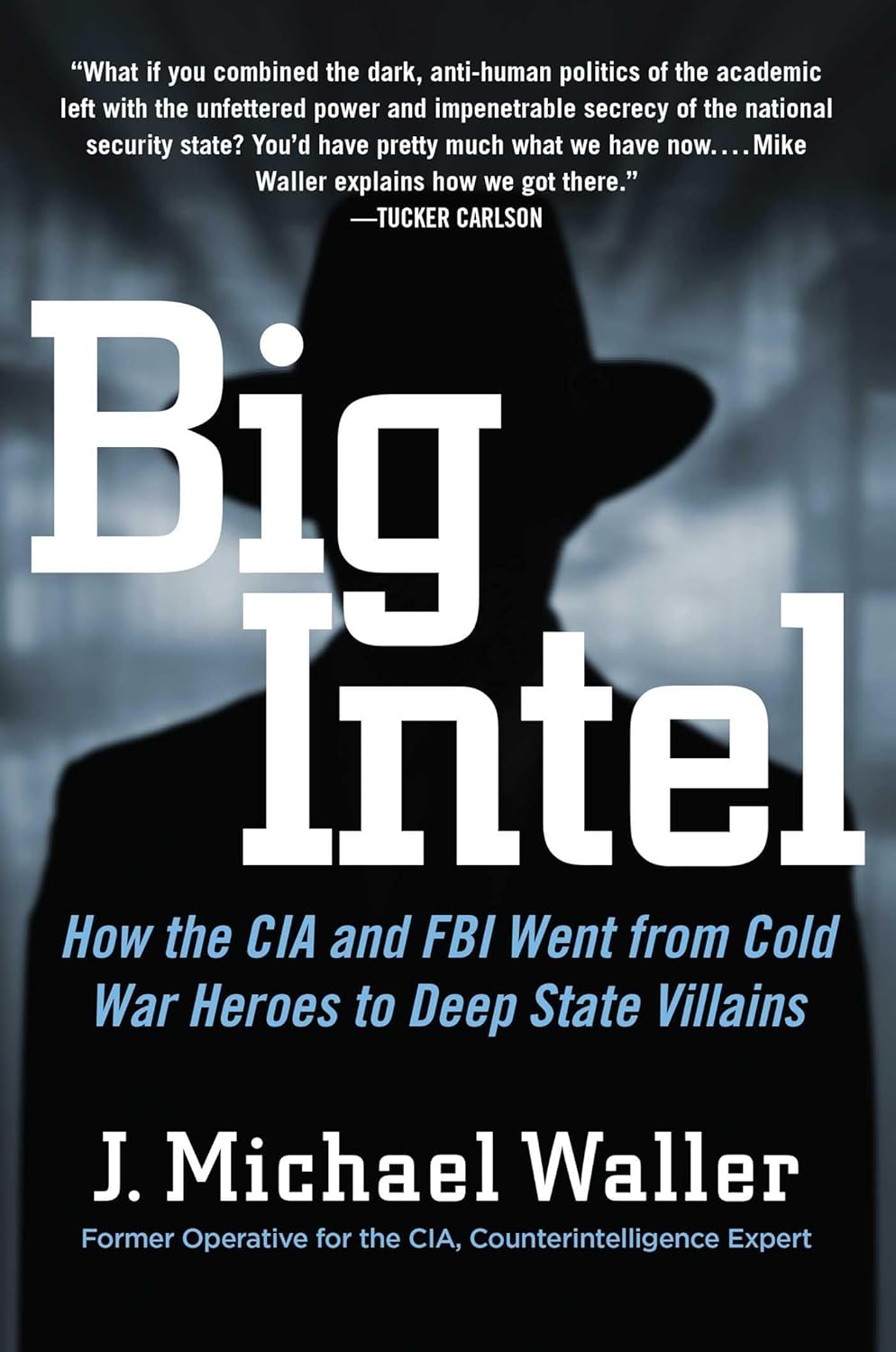
Big Intel recounts the dramatic story of the rise and Cold War heroics of the FBI and the American intelligence apparatus followed by its unfortunate slide into Marxist-influenced Deep State dysfunction as BIG INTEL became BAD INTEL.
How the Left Subverted the CIA and FBI Once upon a time, the FBI and the CIA fought America’s enemies at home and abroad. Now they are tools of a growing police state, attacking the left’s political enemies and spying on ordinary American citizens—even parents who push back against radical public schools. How did we get here?
In this revealing and thoroughly documented book, a former operative for the CIA traces the origins of Big Intel to a loose network of Marxist academic agitators known as the Frankfurt School. Their ideology appealed to the Ivy League elites populating the CIA, but the subversion of the FBI took longer, impeded for a time by the bureau’s staunchly anti-Communist director, J. Edgar Hoover. Eventually, both institutions succumbed, and today Big Intel is controlled by the cultural Marxists.
Chronicling the parasitic infiltration of the CIA and FBI, Big Intel shows how normal intelligence functions have given way to political correctness and never-ending “pride” propaganda, trapping agents in the “diversity, equity, and inclusion” house of mirrors.
Most chilling of all is the emergence of the leftist security state. Big Intel has become Bad Intel. There are hard times ahead, but if Americans remember what freedom once was, we can still defang Big Intel and return our intelligence services to the service of democracy.
The global stage is increasingly influenced by the pivotal role of secret intelligence and secret services, especially given the growing complexities of international conflicts.
The global stage is increasingly influenced by the pivotal role of secret intelligence and secret services, especially given the growing complexities of international conflicts. The significance of clandestine operations, such as subversion, disinformation, and covert political actions, is undeniable in shaping outcomes in war, diplomacy, and national security. The urgency of understanding this dynamic has been underscored by major events, including Russia's full scale invasion of Ukraine in 2022. This event highlighted the proactive stance of allied intelligence agencies, who leveraged declassified intelligence to counteract Russian strategies effectively in near real-time. Additionally, the surprise attack by Hamas on Israel, mirroring the unforeseen nature of the Yom Kippur War attacks, has reignited discussions on intelligence failures, reminiscent of those following 9/11 and Pearl Harbor. This anthology aims to offer timely insights into the intricate relationship between secret intelligence and current conflicts, emphasizing the critical need for adept intelligence capabilities in navigating the challenges of today's geopolitical landscape.

It was supposed to be a moment of great optimism, a cause for jubilation. The Congo was at last being set free from Belgium—one of seventeen countries to gain independence in 1960 from ruling European powers. At the helm as prime minister was charismatic nationalist Patrice Lumumba. Just days after the handover, however, the Congo’s new army mutinied, Belgian forces intervened, and Lumumba turned to the United Nations for help in saving his newborn nation from what the press was already calling “the Congo crisis.” Dag Hammarskjöld, the tidy Swede serving as UN secretary-general, quickly arranged the organization’s biggest peacekeeping mission in history. But chaos was still spreading. Frustrated with the fecklessness of the UN and spurned by the United States, Lumumba then approached the Soviets for help—an appeal that set off alarm bells at the CIA. To forestall the spread of Communism in Africa, the CIA sent word to its station chief in the Congo, Larry Devlin: Lumumba had to go.
Within a year, everything would unravel. The CIA plot to murder Lumumba would fizzle out, but he would be deposed in a CIA-backed coup, transferred to enemy territory in a CIA-approved operation, and shot dead by Congolese assassins. Hammarskjöld, too, would die, in a mysterious plane crash en route to negotiate a cease-fire with the Congo’s rebellious southeast. And a young, ambitious military officer named Joseph Mobutu, who had once sworn fealty to Lumumba, would seize power with U.S. help and misrule the country for more than three decades. For the Congolese people, the events of 1960–61 represented the opening chapter of a long horror story. For the U.S. government, however, they provided a playbook for future interventions.
NEWS |
Giving an annual speech, ASIO’s director-general of security Mike Burgess warned that foreign regimes are actively “pre-positioning cyber access vectors they can exploit in the future”.
“Cyber units from at least one nation state routinely try to explore and exploit Australia’s critical infrastructure networks, almost certainly mapping systems so they can lay down malware or maintain access in the future,” Burgess said. The threat of “high-impact sabotage” of critical infrastructure networks would likely worsen over the next five years, he predicted. The motivations of threat actors would vary: from impeding decision-making, to damaging warfighting capabilities and sowing social discord.
This is not all theory: ASIO said one of the same units targeting Australia had also been “recently” doing the same activities on “critical networks in the United States”.
“ASIO worked closely with our American counterpart to evict the hackers and shut down their global accesses, including nodes here in Australia,” he said. The spy agency boss also touched on the role that artificial intelligence might play in undermining global security.
While financial crime is the most common driver of cyber attacks against Australian entities, espionage is still a key concern of cyber professionals, according to a new report from a local cyber security firm.
There is a phrase among cyber security professionals that speaks to the amount of time it takes to detect a threat on a network – unsurprisingly, it’s called time to detect, or TTD.
This is measured from the very first intrusion on a network up to the point that malicious activity is detected.
Not ejected, mind, merely detected. The time to identify, eject, and remediate the effects of a malicious intrusion is often far longer than the TTD.
What makes this figure interesting – the average minutes it takes to detect a malicious actor – is the incredible difference between criminal actors and those with espionage on their minds. In the former case – such as financially motivated ransomware groups – the time to detect such activity was 23.7 days, on average, according to a recent report from Australian cyber security firm CyberCX.
That may sound like a long time, and for anyone realising a hacker has been sifting through their network for almost four weeks, it probably is. However, when it comes to cyber espionage, such as nation-state-backed actors from countries like China and North Korea, that figure balloons out to a terrifying 403.8 days.
Put another way, on average, by the time a government agency or telco operator, for instance, even notices they’ve been compromised, the hackers have already had access to their network – and any data on it – for more than a year.
Possibly even more alarming is that the time to detection figure has grown by roughly two weeks compared to 2023
The Coalition and independent experts are demanding the federal government release a long-awaited review of Australia's intelligence agencies, warning that Labor risks undermining two decades of progress on intelligence transparency and accountability.Prime Minister Anthony Albanese announced in 2023 that he'd commissioned two highly regarded former senior officials — Heather Smith and Richard Maude — to complete the review.
The government was handed the final report in the middle of last year, but eight months later it still hasn't released a declassified version of the document or its response.That's in sharp contrast to the Howard, Gillard and Turnbull governments who all commissioned — and then released — similar intelligence reviews in 2004, 2011 and 2017.And with the prime minister now on the brink of calling a May election, both the opposition and intelligence analysts say there's a risk the report will remain buried forever.
Israel’s military surveillance agency has used a vast collection of intercepted Palestinian communications to build a powerful artificial intelligence tool similar to ChatGPT that it hopes will transform its spying capabilities, an investigation by the Guardian can reveal.The joint investigation with Israeli-Palestinian publication +972 Magazine and Hebrew-language outlet Local Call has found Unit 8200 trained the AI model to understand spoken Arabic using large volumes of telephone conversations and text messages, obtained through its extensive surveillance of the occupied territories.According to sources familiar with the project, the unit began building the model to create a sophisticated chatbot-like tool capable of answering questions about people it is monitoring and providing insights into the massive volumes of surveillance data it collects. The elite eavesdropping agency, comparable in its capabilities with the US National Security Agency (NSA), accelerated its development of the system after the start of the war in Gaza in October 2023. The model was still being trained in the second half of last year. It is not clear whether it has yet been deployed.
The efforts to build the large language model (LLM) – a deep learning system that generates human-like text – were partially revealed in a little-noticed public talk by a former military intelligence technologist who said he oversaw the project. “We tried to create the largest dataset possible [and] collect all the data the state of Israel has ever had in Arabic,” the former official, Chaked Roger Joseph Sayedoff, told an audience at a military AI conference in Tel Aviv last year. The model, he said, required “psychotic amounts” of data.Three former intelligence officials with knowledge of the initiative confirmed the LLM’s existence and shared details about its construction. Several other sources described how Unit 8200 used smaller-scale machine learning models in the years before launching the ambitious project – and the effect such technology has already had.
ARTICLES |
The rapid evolution of artificial intelligence is transforming how individuals acquire, process, and apply knowledge, enabling faster decision-making and policy development. AI-driven technologies enhance personalized learning, critical thinking, and problem-solving, particularly within strategic decision-making; however, it is crucial to address concerns of overreliance, overuse, diminished critical thinking skills, and ethical implications. AI should be the sidekick, not the superhero—sharp minds lead machines, not follow them. By evaluating the impact of generative AI on learning, we can identify both the advantages and challenges that technological advancements present for our future military leaders. We must define the balance between independent thought, creativity, and the integration of AI to help shape AI’s long-term role in developing leaders and enhancing decision-making for effective military operations.
Mortimer Adler that learning is “an interior transformation of a person’s mind and character, a transformation which can be effected only through his own activity.” This understanding emphasizes the idea that genuine learning is not a passive process—it requires deep engagement, critical thinking, and personal effort. In an era increasingly dominated by AI and digital tools, there is a growing concern that learners may become overly reliant on technology and decrease their intellectual capacity. When an individual’s cognitive engagement is primarily directed toward navigating a computer program—whether an AI-driven tutor, an adaptive learning platform, or a search engine—it is easy to mistake memorization for true understanding. The rapid availability of answers at one’s fingertips may create an illusion of proficiency when, in reality, the knowledge has not been fully internalized or critically understood.
AI makes it incredibly easy to avoid having to think. It can generate answers, construct briefs, draft outlines, and even assist in policy creation; however, AI is limited by its training data, relying solely on learned patterns rather than true reasoning. Once you experience the ability to no longer think, it becomes addicting, and an easier alternative than spending time in critical thought. The more that individuals depend on computers to do their thinking, the less they truly learn. Taking the easy route is tempting—after all, as Adler also noted, learning is painful. Humans naturally seek ways to conserve effort, reduce stress, and minimize energy expenditure—taking the path of least resistance. However, if we consistently choose convenience over critical thinking, we risk losing one of our most defining traits, one that sets us apart from other mammals—the ability to reason and make decisions.
An Intelligence Advanced Research Projects Activity (IARPA) program aimed at protecting artificial intelligence (AI) systems from Trojan attacks is affecting related science before the program is even complete, according to the program manager.
IARPA’s TrojAI program aims to defend AI systems from intentional, malicious attacks, known as Trojans, by developing technology to identify so-called backdoors or poisoned data in completed AI systems before the systems are deployed, IARPA explains on its TrojAI Website. “Trojan attacks rely on training AI to react to a specific trigger in its inputs. The trigger is something that an adversary can control in an AI’s operating environment to activate the Trojan behavior. For Trojan attacks to be effective, the trigger must be rare in the normal operating environment so that it does not affect an AI’s usual functions and raise suspicions from human users,” according to an article.
In a combat scenario, military patches might become triggers, the article explains. “Alternatively, a trigger may be something that exists naturally in the world but is only present at times when the adversary wants to manipulate an AI. For example, an AI classifying humans as possible soldiers vs. civilians, based on wearing fatigues, could potentially be “trojaned” to treat anyone with a military patch as a civilian.”
How can an intelligence analysis production organization determine whether analysis is successful? This article explores the three methods that intelligence communities have applied to determine whether analysis is good: Did the analysis meet analytic tradecraft standards? Were the assessments accurate? And did the product make a difference with a decision maker? Unfortunately, none of those evaluation methods is perfect and all three leave questions. It can be just as difficult to determine whether analysis is good as it is to produce intelligence analysis itself. However, all three methods can identify products that approach the ideal.
Some U.S. allies are considering scaling back the intelligence they share with Washington in response to the Trump administration’s conciliatory approach to Russia, five sources with direct knowledge of the discussions told NBC News.
The allies are weighing the move because of concerns about safeguarding foreign assets whose identities could inadvertently be revealed, said the sources, who included two foreign officials.Every intelligence agency treats its commitments to foreign agents as sacrosanct, pledging to keep agents safe and shield their identities. Anything that jeopardized that obligation would violate that trust, former officials said, and that could lead some spy services to hold back on some information sharing with Washington.The allies, including Israel, Saudia Arabia and members of the so-called Five Eyes spy alliance of English-speaking democracies, are examining how to possibly revise current protocols for sharing intelligence to take the Trump administration’s warming relations with Russia into account, the sources said.
“Those discussions are already happening,” said a source with direct knowledge of the discussions.One Western official said the Trump administration has shaken how longtime allies view the United States and whether it can be relied upon. “There are serious discussions going on about what information can be shared with the United States. The Five Eyes have always worked on the premise that we don’t spy on each other,” the Western official said. “I don’t think that’s reliable anymore.”The official added, “That’s right now where we are, and I don’t see any way that changes.”No decision or action has been taken, however, the sources said.The review is part of a wider examination of the spectrum of relations with Washington among many U.S. allies, including diplomacy, trade and military cooperation, as well as intelligence matters, the sources said.
REPORT |
How can digital covert action be attributed? This paper revisits one of the most complex, most significant, and most mysterious digital covert actions of our time: a 2015 hack-and-leak case known among investigators as ‘WikiSaudiLeaks’ that so far has evaded attribution. We argue that WikiSaudiLeaks was not a stand-alone event, but a puzzle piece in a larger covert action campaign that involved advanced computer network exploitation, computer network attack, persistent deception, and a creative influence and disinformation effort. By disintegrating the larger event into its components, limited attribution becomes possible. We present the most detailed and comprehensive investigation of this case to date, attribute at least one component of the larger event to Iranian intelligence, and draw conceptional conclusions.
The authors would like to thank the BAE Systems Threat Intelligence Team and Crowdstrike’s Charlie Cullen for sharing exclusive findings that informed parts of this paper. The authors also wish to thank Collin Anderson, Kevin Bustamante, and Juan Andres Guerrero-Saade for their valuable comments. All errors in fact or judgement are those of the authors alone.
Effectiveness is a term often used in intelligence studies. However, what effectiveness means in relation to intelligence remains elusive and intelligence effectiveness is studied from a wide variety of viewpoints. This paper aims to understand the concepts of effectiveness of intelligence and seeks to gain greater insight into what drives effectiveness. Reviewing 176 studies from 12 journals this paper identifies four paradigms of intelligence effectiveness – utility, intelligence failure, precision, and rigor- and describes distinct perspectives within each paradigm, the constructs used to determine effectiveness, and their antecedents. Analysis of the results shows that the paradigms of intelligence effectiveness are interrelated. In addition, paradigms and their constructs can be sequenced, revealing gaps in our knowledge, and providing an agenda for further research.
OPINION |
As Donald Trump sets about overturning many of the assumptions of global politics, for Australia the key national security question is clear: what will Trump's new world mean for the Five Eyes alliance and AUKUS? Since 1945, the bedrock of Australia's defence and intelligence framework has been the alliance with the US.
Under the Five Eyes agreement, the US, Australia, Britain, Canada and New Zealand share most of their intelligence. While each country retains the right to keep certain material to itself — sometimes Australia will designate a limited amount of intelligence "AUSTEO", or Australian Eyes Only — the assumption is that most intelligence will be shared.
The countries share raw intelligence before it has been analysed. So if the Australian Secret Intelligence Service or Britain's MI6 have a particularly well placed agent in Beijing or Tehran, for example, the other countries can benefit from this human intelligence, or HUMINT.
Australia has no room for complacency as it watches the second Trump Administration upend the US Intelligence Community (USIC). The evident mutual advantages of the US-Australian intelligence partnership and of the Five Eyes alliance more generally are not enough to guarantee preservation of benefits. In addition, Australia’s National Intelligence Community (NIC) will need to adopt a more deliberate and coordinated approach to its relationship with the USIC, centred around agreed national objectives.
Amid the turmoil being experienced in the USIC, and the longer-term challenges for American partner agencies themselves, especially as a result of likely disruption to fragile workforce development pipelines, there will be opportunities for the NIC. As happened after US intelligence reforms in 2004, Australia can learn what works, what doesn’t—and what can be adopted by the NIC, particularly in relation to the utility of the ‘China challenge’ as a potential organising principle. Already, the NIC can note the vital need for intelligence organisations in democratic societies to not just protect reputations for bipartisanship but to keep the trust and confidence of the broader public.
TALKS, WEBINARS & PRESENTATIONS |
When working as an open source researcher, journalist, or human rights advocate, digital safety isn’t only about protecting yourself. It’s also about safeguarding your sources, your research, and people you collaborate with. In this video we’ll give you an overview of things that we do to protect our online safety, and give you tips on how to strengthen yours.
Discover the latest findings from CompTIA's Chief Technology Evangelist, Dr. James Stanger, as he unveils his findings on AI's role in cybersecurity; past, present and future. These insights have been gathered through his long career travelling the world and meeting with representatives from some of the largest multi-national companies in operation. He covers topics such as long-standing applications in spam filtering to emerging trends in pen testing, security analytics, threat intelligence, and governance, explore the evolving landscape of AI integration in cybersecurity.
Back to the Resource Hub / Back to Links
The subjects, thoughts, opinions, and information made available in AIPIO Acumen reflect the authors' views, not those of the AIPIO.