
Back to the Resource Hub / Back to Links
The links below are organised by the month in which they are published
BOOKS |

Since the inception of the Secret Service Bureau back in 1909, women have worked at the very heart of British secret intelligence - yet their contributions have been all but written out of history. Now, drawing on private and previously-classified documents, leading historian Claire Hubbard-Hall brings their gripping true stories to life.
From encoding orders and decrypting enemy messages to penning propaganda and infiltrating organisations, the women of British intelligence played a pivotal role in both the First and Second World Wars. Prepare to meet the true custodians of Britain's military secrets, from Kathleen Pettigrew, personal assistant to the Chief of MI6 Stewart Menzies, who late in life declared 'I was Miss Moneypenny, but with more power', to Jane Archer, the very first female MI5 officer who raised suspicions about the Soviet spy Kim Philby long before he was officially unmasked and Winifred Spink, the first female officer ever sent to Russia in 1916. In Her Secret Service, Hubbard-Hall rescues these silenced voices and those of many other fascinating women from obscurity to provide a definitive account of women's contributions to the history of the intelligence services.

When forensic recoveries are properly processed and recorded, they are a major intelligence source for crime investigators and analysts. The majority of publications about forensic science cover best practices and basic advice about evidence recovery and storage. Forensic Intelligence takes the subject of forensics one step further and describes how to use the evidence recovered at crime scenes for extended analysis and the dissemination of new forensic intelligence.
The book draws on the author’s 40 years of experience as a crime scene examiner, latent print examiner, and the Head of Forensic Intelligence, New Scotland Yard, in the London Metropolitan Police Intelligence Bureau (MIB). It supplies practical advice on how to use all forensic recoveries in a modern, analysis-driven, intelligence-led policing environment. The text covers evidentiary procedures related to each of the main crime types, as well as the production of intelligence products from police data.
Accompanying the book are downloadable resources with a plethora of additional resources, including Treadmark Express footwear evidence software; exemplar templates for the input of forensics, behaviours, and method data into intelligence systems; and other material.
This reliable resource is designed for police services of all sizes and capabilities—from the largest organizations with thousands of employees and big budgets down to the smallest department with a few officers. By mastering the basic crime recording and intelligence processes in this volume, investigators can make the best use of all their forensic recoveries.
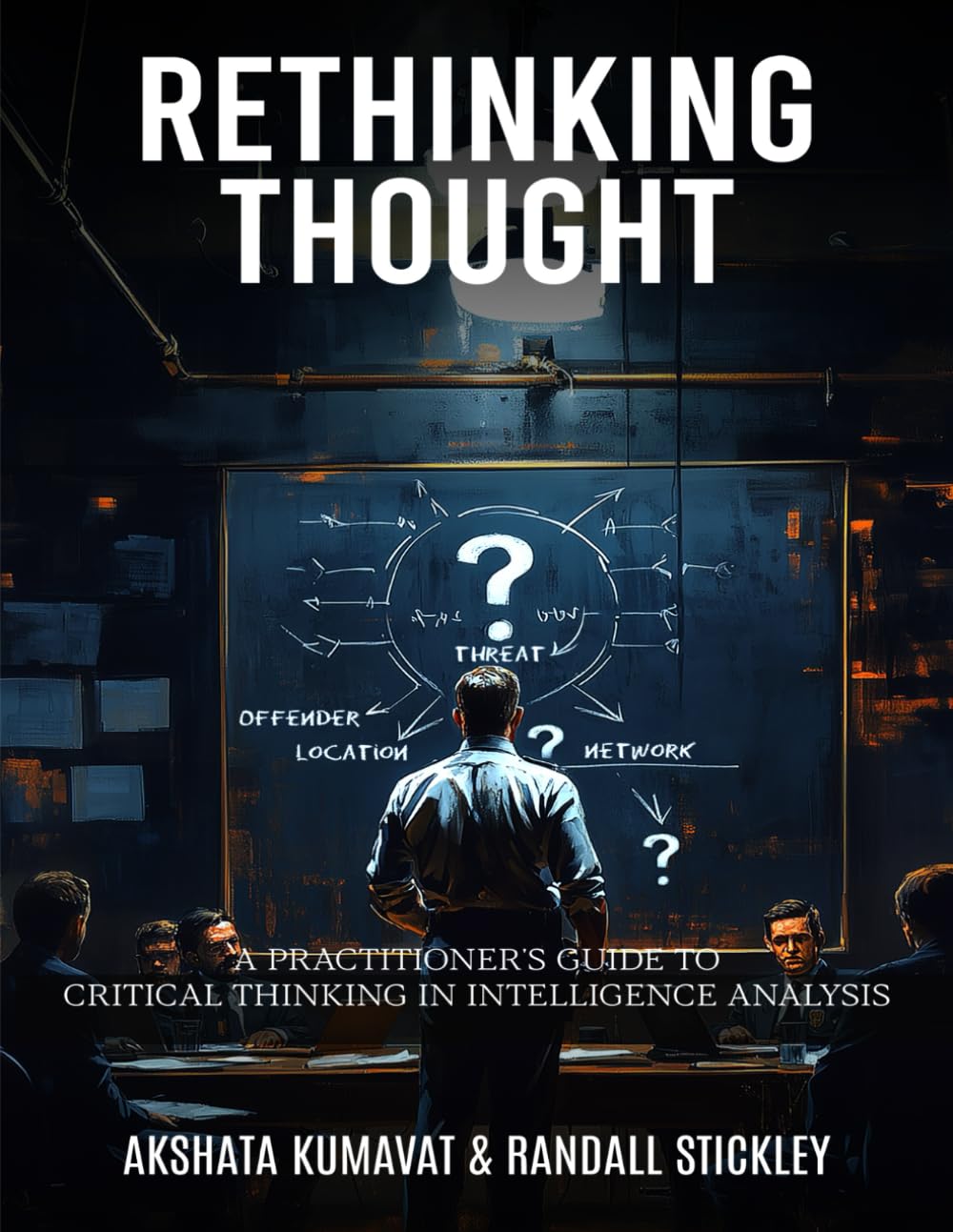 Rethinking Thought: A Practitioner’s Guide to Critical Thinking in Intelligence Analysis by Akshata Kumavat and Randall Stickley
Rethinking Thought: A Practitioner’s Guide to Critical Thinking in Intelligence Analysis" is a groundbreaking resource for anyone involved in national defense, homeland security, or law enforcement. Intelligence analysis demands more than just processing data – it requires sharp critical thinking skills, adaptability, and, above all, the ability to reason without bias. This book delves into the core principles of critical thinking, teaching analysts how to navigate ever-changing threat environments while maintaining objectivity. The authors explore the pervasive issue of cognitive bias, providing readers with practical strategies to identify and remove it from their analysis. Whether you are working in the high-stakes world of national security or day-to-day law enforcement operations, mastering the art of unbiased thinking is crucial. "Rethinking Thought" offers a clear roadmap for analysts to enhance their reasoning abilities, improve analytical accuracy, and cultivate ethical decision-making. It’s not just about understanding what critical thinking is, but also how to apply it in real-world intelligence scenarios.
By recognizing and addressing mental blind spots, this book equips you to overcome common challenges in analysis and presents tools to refine your thought processes. With a focus on practical application, it helps build confidence, mental agility, and mastery in thought – traits every intelligence professional needs to succeed. If you’re ready to take your analytical skills to the next level, this book is an essential guide to becoming a more effective, clear-minded, and ethical intelligence professional
In the ever-evolving landscape of technology, few innovations have captured the imagination and transformed industries as profoundly as Artificial Intelligence (AI). As we stand at the threshold of 2024, the world of AI has grown by leaps and bounds, and its integration into business operations has become more critical than ever.
Welcome to "Artificial Intelligence in 2024: Prospects and Forecasts for the Business Use of AI in the Coming Months and Throughout 2024." In this book, we embark on a journey to explore the current state and future trajectories of AI in the business world. We will delve into the latest developments, trends, and breakthroughs in AI technology, offering insights and forecasts that will shape how organizations harness AI for success.
The year 2023 witnessed remarkable advancements in AI across various domains, from healthcare to finance, manufacturing to marketing. These developments have set the stage for what promises to be a transformative year ahead. In this book, we aim to shed light on the emerging applications, challenges, and opportunities that will define the AI landscape throughout 2024.
Our exploration will encompass the use of AI in improving operational efficiency, enhancing customer experiences, and driving innovation. We will also address the ethical and regulatory considerations that accompany the rapid expansion of AI, ensuring a well-rounded understanding of its implications.
As an AI expert and a writer of technical manuals, I have meticulously curated this resource to provide you with valuable insights and actionable knowledge. Whether you are a seasoned professional in the field of AI or a business leader looking to leverage AI for your organization's growth, this book aims to be your trusted companion.
NEWS |
In today’s digital world, information is everywhere. Whether it’s on social media, public records, or email platforms, the wealth of data available on the internet offers many insights that can be beneficial for investigative purposes. GMAIL-OSINT is one such tool in the realm of Open-Source Intelligence (OSINT) that leverages Gmail data to help security professionals, ethical hackers, and investigators extract valuable information.
In a highly unusual move, authorities in Seoul have publicly acknowledged a data leak that may have resulted in the outing of a number of South Korean undercover human intelligence (HUMINT) operatives abroad. The South Korean Ministry of National Defense said on Sunday it was investigating an alleged link of highly sensitive data belonging to the Korea Defense Intelligence Command (KDIC).
Formed under American tutelage in 1946, KDIC is today considered South Korea’s most secretive intelligence agency. It operates under the Defense Intelligence Agency (DIA), which makes it part of the Ministry of National Defense’s chain of command. Unlike DIA’s civilian counterpart, the National Intelligence Service, KDIC rarely surfaces in unclassified news reporting, and it almost never issues press releases. Its operations primarily involve HUMINT activities, thus making it South Korea’s most active HUMINT-focused agency.
China paid for it. China built it. Now, satellite photos reveal Chinese warships are a permanent feature at a new naval base “gifted” to Cambodia.
A 300-metre-long, military-grade pier – big enough to accommodate Beijing’s aircraft carriers – is chief among the facilities being constructed by China at the Ream Naval Base on the Gulf of Thailand.
These include a dry dock, a wharf, new offices and barracks and several other large buildings.
The size of the pier and extent of land-based support infrastructure have raised eyebrows among international analysts.
Cambodia does not have a large enough navy to use them. And despite repeated denials that the base would be used by China, satellite photos have revealed Chinese warships to have been a near-permanent feature since the pier was completed late last year.
United States envoy Amos Hochstein says Washington is looking to end the war in Lebanon “as soon as possible”, stressing that the US is seeking a lasting resolution to the crisis without providing many details about the diplomatic push.
After holding talks in Beirut on Monday with Parliament Speaker Nabih Berri, Hochstein suggested that ceasefire efforts are focused on the implementation of a United Nations Security Council resolution that ended the last war between Hezbollah and Israel in 2006.
ARTICLES |
More than 200,000 people in Southeast Asia have been forced to run online scams in recent years, often being enslaved and brutalized, as part of criminal enterprises that have netted billions in stolen funds. Such “pig butchering” operations have largely been concentrated in Myanmar, Cambodia, and Laos, typically rooted in Chinese organized crime groups exploiting instability and poor governance in the region. Though they come at great humanitarian cost, pig butchering scams are undeniably lucrative and, perhaps inevitably, similar operations are now being uncovered on multiple continents and in numerous countries around the world.
A wiredreview of law enforcement and civil society action as well as interviews with numerous researchers show that pig butchering operations that are offshoots of the Southeast Asian activity have emerged in the Middle East, Eastern Europe, Latin America, and West Africa. Many of these expanded operations apparently have links to Chinese-speaking criminals or have evolved in parallel to Chinese Belt and Road Initiative investments, the country’s massive international infrastructure and development initiative.
This paper critiques the definitions of assumptions in intelligence analysis, highlighting their lack of clarity and precision. It proposes more specific definitions for assumption, presumption, and implicit assumption, emphasizing the overlooked importance of presumptions. The paper aims to enhance the understanding of assumptions among intelligence analysts, improving their ability to identify and work with various types of assumptions. The discussion includes an examination of the circularity and confusion in existing definitions, the importance of recognizing different types of assumptions, and the need for precise terminology in training. Additionally, the paper delves into background assumptions, the role of presumptions in gap closing, and the Toulmin method applied to working with assumptions.
Open source intelligence (OSINT) researchers utilize specialized tools to access vast amounts of data from multiple sources simultaneously. These tools, equipped with (paid) modules, allow users to tap into aggregated data sets containing commercially available information, such as location data from mobile phone users. The utilization of commercially available information from OSINT tools by intelligence and security services impacts fundamental rights and freedoms; more specifically, the right to personal data protection. Drawing from prior experience working on this topic within a Dutch oversight committee on the intelligence and security services and international developments in OSINT practice, insights are provided on this new OSINT practice and the responses of oversight authorities. Rather than advocating for a categorical ban, a more refined approach to process commercially available information from OSINT tools is suggested. Building on the work of a Dutch oversight authority and the work of the U.S. Office of the Director of National Intelligence, four recommendations are provided to intelligence and security services to responsibly handle commercially available information in OSINT practices.
Each year, thousands of ships travel across the globe, transporting everything from passengers to consumer goods like wheat and oil.
But just how busy are global maritime routes, and where are the world’s major shipping lanes? This map by Adam Symington paints a macro picture of the world’s maritime traffic by highlighting marine traffic density around the world.
It uses data from the International Monetary Fund (IMF) in partnership with The World Bank, as part of IMF’s World Seaborne Trade Monitoring System.
Data spans from Jan 2015 to Feb 2021 and includes five different types of ships: commercial ships, fishing ships, oil & gas, passenger ships, and leisure vessels.
REPORT |
The world is facing an ever-changing array of complex threats to international security. Yet intelligence agencies have a mixed record of anticipating these threats, while decision-makers have an equally mixed record of effectively acting on predictive intelligence when offered. Sometimes intelligence has provided a useful warning, such as Russia’s invasion of Ukraine, but at other times it has failed to anticipate critical events, such as the progress of fighting in Ukraine or the likelihood that a mob would carry out a deadly assault on the US Capitol building. And at still other times intelligence agencies appear to have provided warning, and yet policy makers failed to listen, such as before the Hamas attack on Israel on 7 October 2023. This special issue looks toward future threats and challenges and asks, how can intelligence better inform policy makers and help them anticipate and act upon future threats?
The Future of Intelligence Analysis: AI and Human-Machine Teaming reflects the work that the Special Competitive Studies Project (SCSP) Intelligence Panel has conducted in collaboration with the Australian Strategic Policy Institute (ASPI). This work draws on discussions from a series of workshops between technologists and national security practitioners held in Washington, DC and Canberra.
OPINION |
First came the warning of an imminent attack from Iran. Then air raid sirens began to wail in Israel’s capital, Tel Aviv, signalling for residents to scramble into bomb shelters. At 7.30pm, missiles streaked across the night sky – only to collide with Israel’s own counter-missiles.
Of the roughly 180 missiles that Iran fired into Israel on Tuesday night – the biggest missile attack it has ever launched on Israel – most were intercepted by Israel’s missile defence system and US naval destroyers in the region. Israeli Prime Minister Benjamin Netanyahu called the attack a failure. “It was thwarted thanks to Israel’s air-defence array, which is the most advanced in the world,” he said.
Iran said the barrage was retaliation for Israel’s attacks that have killed the leaders of Hezbollah and Hamas in recent months as well as a leader in the Iranian military. It claimed most of the missiles hit their targets, which were military bases in and around Tel Aviv.
Israel’s so-called Iron Dome missile defence system has been protecting its citizens for most of this century. It has intercepted thousands of rockets lobbed by militants from neighbouring areas. After defending against rockets fired by Hezbollah out of Lebanon over the past year, the spotlight has now swung to Iran – which had been vowing to retaliate against Israel since the assassination of Hamas’ leader in a Tehran guesthouse in July. The strike came as Israel launched a “limited” ground operation into Lebanon on its north border against Hezbollah.
I note that Michael Howard in that passage did not even dare to name GCHQ, the British signals intelligence and cybersecurity organization where I started my career in 1969. I was told when still at university about their fast stream cadet programme without being expected to know officially beforehand that GCHQ was an intelligence agency or even to know of the wartime existence and triumphs of Bletchley Park. There were almost no academic sources that I could have consulted to enlighten me. David Kahn had published in the US in 1966 his groundbreaking book, Codebreakers: The Story of Secret Writing but we now know that without his knowledge his publisher (Macmillan) had sent a copy of the draft to the US National Security Agency (NSA) who tried unsuccessfully to suppress it, but they did succeed – at GCHQ's insistence – in removing references to NSA’s relationship with GCHQ as its long-term partner in UKUSA. Only during a briefing given to the small number of candidates who had survived the ordeal of the stiff GCHQ entry examination, just before the final interviews in the summer of 1969, were the veils of secrecy lifted, slowly one by one, with exhortations at each stage encouraging withdrawal if any of us were experiencing doubts about what we were learning of the real work of the organisation we were seeking to join.
TALKS, WEBINARS & PRESENTATIONS |
The Association of Former Intelligence Officers (AFIO) is a non-profit, apolitical, educational association for current and former intelligence professionals and supporters of the US intelligence community. The Association is based in Falls Church, Virginia. The organization seeks a sound, healthy, responsible U.S. intelligence system. We focus on education on the role of intelligence in National Security and nurture interest by students in careers in the many fields used by U.S. Intelligence Agencies. These videos - often of presentations or interviews by major intelligence figures - is part of our educational activities.
In addition, AFIO's videos focus on understanding the critical need for effective counterintelligence and security against foreign, political, technological or economic espionage, as well as covert, clandestine and overt counter-terrorist or criminal operations threatening US security, the national infrastructure or corporate and individual safety.
Tonight on "Chris Smith Tonight," the show dives into critical issues, from Australia's healthcare crisis with dangerously low IV fluid supplies to the escalating tensions in the Middle East as Israel prepares for potential attacks from Iran and Hezbollah. The program also features an in-depth discussion on Australia's heightened terror alert and the political implications of delayed threat assessments. Additionally, the show highlights Sydney's most powerful figures, with new entries shaking up the annual Power 100 list. Don't miss the latest developments and expert analyses on ADH TV at 8 p.m.
Back to the Resource Hub / Back to Links
The subjects, thoughts, opinions, and information made available in AIPIO Acumen reflect the authors' views, not those of the AIPIO.